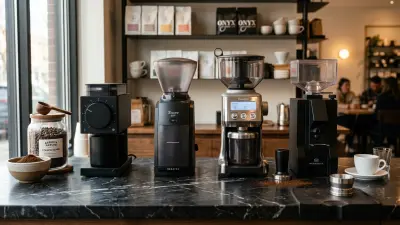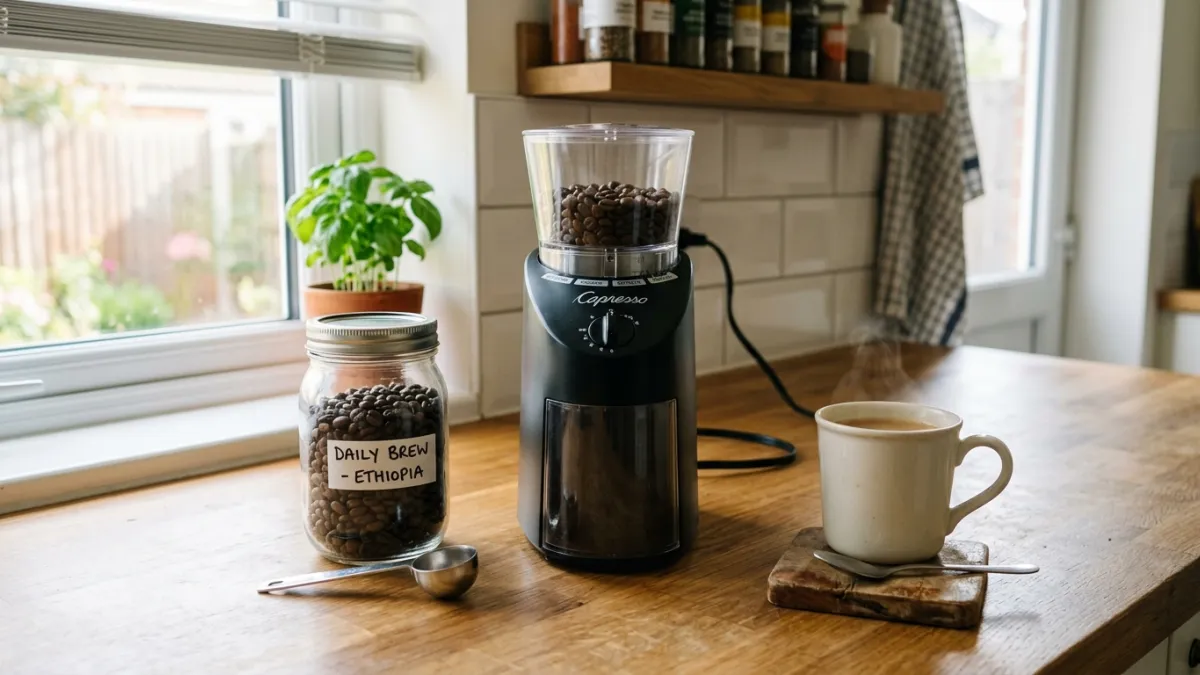
Quick answer: The Baratza Encore ESP ($199) stands out as the ultimate entry-level all-rounder for 2025, providing micro-adjustments for true espresso dialing along with stellar filter performance. For purely drip, pour-over, or French press coffee, the Fellow Opus ($195) offers sleek design and ultra-low retention, while the OXO Brew Conical burr grinder ($100) remains the most cost-effective option for budget-conscious filter coffee drinkers.
Why Burr Grinders Are Essential for Home Brewing
The core mechanism of coffee extraction relies entirely on surface area contact between hot water (ideally 90–96 °C or 195–205 °F according to Specialty Coffee Association standards) and ground coffee. When using a blade grinder, particle sizes range wildly from coarse bits to fine dust within the same basket. During a typical brewing process, water extracts Soluble solids from tiny particles almost instantly, resulting in bitter compounds, while larger chunks remain under-extracted and sour. A quality burr grinder maintains consistent physical spacing, producing ground particles that fall within narrow micron ranges—typically 250 to 500 microns for espresso and 600 to 1200 microns for coarse immersion brews like French press.
Investing in uniform grind size allows home baristas to standardize recipe variables, such as dose weight and extraction speed. For instance, dialing in an 18 g dose with a standard 1:16 coffee-to-water ratio becomes reliable and repeatable only when your grind size stays identical from batch to batch. Burr set geometry, whether conical or flat, ensures that coffee beans pass through the grinding chamber only once they reach the designated particle clearance. This level of mechanical control forms the foundation of balanced extraction, unlocking subtle origin notes, sweetness, and pleasant acidity in your cup.
Barista's tip: Water retention and static inside a grinder's chute (often called grinder retention) can cause old coffee grounds to mix into your fresh dose. To reduce static cling and keep grounds flowing freely into your catch cup, spray a single drop of water onto your whole coffee beans prior to grinding—a technique widely known in the specialty coffee community as the Ross Droplet Technique (RDT).
Top Budget Burr Grinders Evaluated for 2025
When selecting the best affordable coffee grinders for this year, our evaluation prioritized grind consistency across multiple brew methods, ease of maintenance, burr longevity, and real-world daily usability. A great budget grinder must deliver consistent results whether you are aiming for a 2:30 pour-over drawdown or a 28-second espresso extraction. The following models represent the absolute best balance between cost, performance, and build quality available today.
1. Baratza Encore ESP
Building on the iconic legacy of the original Baratza Encore, the Encore ESP is specifically re-engineered to tackle both filter coffee and genuine espresso brewing. Equipped with 40mm M2 stainless steel conical burrs, the unit features a dual-range adjustment system. Settings 1 through 20 deliver high-resolution micro-adjustments designed for fine-tuning espresso shots, while settings 21 through 40 provide macro-adjustments perfectly calibrated for V60 pour-overs, AeroPress, Chemex, and French press.
Baratza remains the gold standard for long-term sustainability because every single part of the machine is easily replaceable and user-repairable. The Encore ESP includes an quick-release burr assembly that simplifies routine cleaning without tools. While its motor sound is somewhat loud compared to premium units, its particle uniformity, reliable customer support, and ability to grind fine enough for unpressurized espresso baskets make it an unbeatable long-term investment under $200.
2. Fellow Opus Conical Burr Grinder
The Fellow Opus brings high-end aesthetic design and single-dosing features to the entry-level market. Powered by 40mm 6-blade conical burrs, the Opus is capable of grinding across the entire spectrum, spanning from fine espresso to coarse cold brew. Its integrated volumetric dosing lid, anti-static catch cup technology, and compact footprint make it one of the cleanest electric grinders to operate on a kitchen counter.
Adjustment on the Fellow Opus includes 41 primary outer steps plus an internal micro-adjustment ring for precision dialing. While the dual-ring system can take a bit of practice to learn initially, the grinder excels in producing clean, vibrant filter coffee and sweet espresso shots. With ultra-low retention (around 0.5 g) and significantly quieter operation than most competitors, the Opus is ideal for modern home coffee bars.
3. OXO Brew Conical Burr Coffee Grinder
For home coffee drinkers strictly focused on filter coffee—such as automated drip machines, French press, and pour-overs—the OXO Brew Conical Burr Grinder remains the ultimate budget entry point. It utilizes 40mm stainless steel conical burrs and offers 15 main macro settings with micro-steps totaling 40 overall positions. The simple one-touch dial remembers your last timer setting, allowing you to press one button for consistent morning dosing.
Although the OXO Brew cannot grind fine or uniform enough for true espresso machines, its performance on medium and coarse settings easily outperforms any blade grinder. The grounds container is wrapped in stainless steel to help tame static cling, making daily cleanup quick and hassle-free. It offers an exceptional user experience for under $100 without overcomplicating your routine.
4. Kingrinder K6 (Manual Hand Grinder)
If maximum grind performance per dollar is your priority and you do not mind manual cranking, hand grinders like the Kingrinder K6 provide remarkable precision. Featuring 48mm heptagonal stainless steel burrs and an exterior adjustment collar with 16 microns per click, the K6 rivals electric grinders costing three times as much. Manual grinders eliminate electric motor costs, allowing manufacturers to put full budget into ultra-precise burr alignments and bearings.
Grinding an 18 g espresso dose takes roughly 35 to 45 seconds on the K6, while pour-over doses take under 25 seconds. Its exceptional particle uniformity generates minimal fines, producing clean taste clarity, bright acidity, and balanced extraction yields in filter brewing. It is also portable, making it a great travel companion alongside an AeroPress.
Feature Comparison: Budget Burr Grinders for 2025
Comparing technical specs helps pinpoint which grinder fits your primary brewing methods and space limitations. The table below outlines key specifications for top budget burr grinders across price points, burr configurations, and ideal use cases.
| Grinder Model | Burr Type & Size | Adjustment Range | Best Brew Methods | Key Advantage |
|---|---|---|---|---|
| Baratza Encore ESP | 40mm Conical Steel | 40 Settings (Dual-Range) | Espresso, Pour-over, Drip, AeroPress | Repairable parts, high espresso precision |
| Fellow Opus | 40mm Conical Steel | 41 Outer + Inner Micro | Pour-over, AeroPress, Espresso, Cold Brew | Low retention, sleek quiet design |
| OXO Brew Burr | 40mm Conical Steel | 15 Main / 40 Micro Steps | Drip Machine, French Press, Pour-over | Incredible value under $100, simple timer |
| Kingrinder K6 | 48mm Heptagonal Steel | 240 Clicks (16 µm per click) | Pour-over, Espresso, AeroPress, V60 | Commercial-grade clarity at low cost |
How to Select the Right Grinder for Your Setup
Choosing the ideal grinder comes down to identifying your primary coffee style, workflow preferences, and budget limits. If your daily routine revolves strictly around drip coffee pots or pour-over drippers, high-end espresso dialing features are unnecessary. Focus on user-friendly interface designs, low noise levels, and simple burr cleaning routines. Conversely, if you plan to purchase an espresso machine in the near future, ensure your chosen grinder features step sizes under 20 microns per setting so you can fine-tune shot times effectively.
Additionally, consider bean capacity and retention habits. Single-dosing home baristas who weigh whole beans before grinding benefit most from low-retention units like the Fellow Opus or manual hand grinders. Hoppe-fed setups like the Baratza Encore ESP or OXO Brew work better for households brewing larger 60 g to 70 g pots of filter coffee daily. Factor in bean freshness as well: freshly roasted beans (2 to 4 weeks off roast date) grind much more consistently and retain fewer static charges than older, oil-coated dark roasts.
- For Espresso Enthusiasts: Choose the Baratza Encore ESP or Kingrinder K6 for micro-adjustment capabilities.
- For Filter & Pour-Over Purists: Opt for the Fellow Opus or Baratza Encore for clean particle distribution and low retention.
- For Budget Drip Coffee Drinkers: Pick the OXO Brew Conical Burr Grinder for quick daily convenience.
- For Travelers & Minimalists: Select a manual hand grinder for high precision without electric power requirements.
If you primarily brew filter coffee, pour-over, or drip and want an easy, repairable electric grinder that lasts for years, start with the Baratza Encore ESP. Paired with fresh beans, quality water, and a standard 1:15 to 1:17 brew ratio, this single gear upgrade will transform the sweetness, clarity, and body of your daily cup.
Frequently Asked Questions
Are budget burr grinders really better than expensive blade grinders?
Yes, significantly. Blade grinders slice coffee beans unevenly, creating a wide mix of extra-fine dust and large chunks that cause simultaneous over-extraction and under-extraction. Burr grinders crush coffee beans to a uniform particle size, resulting in balanced extraction and vastly superior flavor in every cup.
Can I grind espresso with a budget electric burr grinder?
Yes, but you need a grinder specifically designed with micro-adjustments fine enough for espresso pressure, such as the Baratza Encore ESP or Fellow Opus. Standard entry-level grinders like the base OXO Brew lack the small step adjustments required to properly dial in shot extraction times.
How often should I clean my burr grinder?
You should clean your burr chamber every 2 to 4 weeks depending on usage and roast style. Dark oily roasts build up residue faster than light roasts. Simply unplug the grinder, remove the hopper, brush off ground coffee buildup on the burrs, and vacuum out loose particles inside the chute.
Why is my grinder producing so much static and mess?
Static electricity builds up as coffee beans rub against metal and plastic parts during grinding, especially in low-humidity environments. Applying a light mist of water to your coffee beans before grinding (the Ross Droplet Technique) neutralizes static charge and keeps grounds from sticking to the catch bin.