Quick answer: A 1:16 coffee-to-water ratio serves as the standard starting point for pour over coffee, which equals roughly 15 to 16 grams of medium-fine coffee grounds for every 250 grams (or ml) of water. For a lighter, more delicate cup, adjust to 1:17, or tighten the ratio to 1:15 for a bolder brew with heavier body.
Understanding the Science of Coffee Ratios
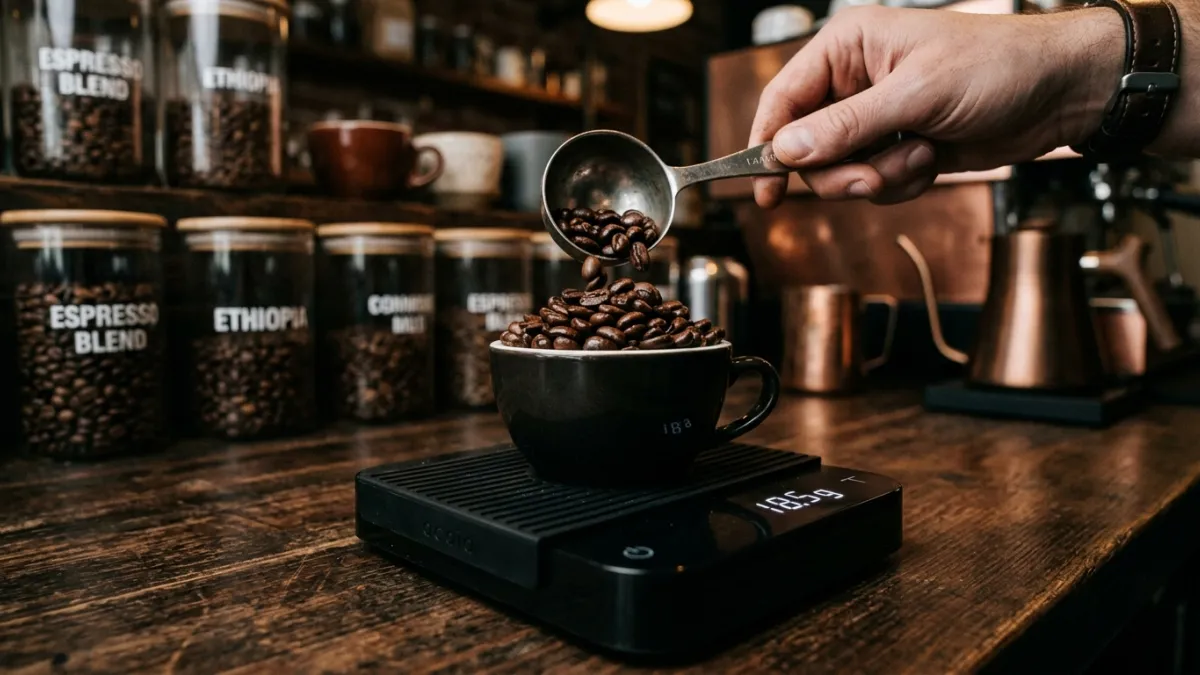
The brew ratio represents the proportional weight of dry coffee grounds relative to the total mass of brewing water. Because coffee beans vary dramatically in density based on cultivar, elevation, and roast level, measuring by volume with scoops leads to inconsistent results. Measuring both coffee and water by weight in grams provides absolute precision, allowing you to reproduce your ideal cup reliably every single morning.
Extraction is the process where water dissolves flavor compounds, acids, sugars, and aromatic oils from ground coffee beans. According to Specialty Coffee Association (SCA) standards, optimal extraction yields a total dissolved solids (TDS) level between 1.15% and 1.45%, corresponding to an extraction yield of 18% to 22%. Deviating from a balanced ratio disrupts this balance: using too much water leads to over-extraction and bitter woodiness, while too little water yields an under-extracted brew dominated by sour, sharp acids.
Water density makes calculating these ratios straightforward because one milliliter of clean water at brewing temperature weighs approximately one gram. Therefore, a target yield of 300 ml of brewed coffee requires 300 grams of total water poured over the bed of grounds. Thinking in terms of mass rather than fluid volume ensures that adjustments remain scalable regardless of whether you are brewing a single mug or a large carafe.
The Golden Ratio Spectrum for Pour Over Methods
While coffee culture frequently cites the "Golden Ratio," pour over brewing actually thrives along a customizable spectrum ranging from 1:15 to 1:17. Selecting the correct ratio within this range depends primarily on your roast profile, bean origin, and individual taste preference. Lower numerical ratios produce concentrated brews with more tactile weight, whereas higher ratios emphasize delicate, floral, and fruity tasting notes.
A 1:15 ratio (20 g coffee to 300 g water) produces a rich, heavy-bodied cup that works exceptionally well for medium-dark or dark roasts, as well as milk-friendly pours. The standard 1:16 ratio (18.7 g coffee to 300 g water) acts as the universal benchmark, balancing sweet caramelization with sparkling acidity. A 1:17 ratio (17.6 g coffee to 300 g water) shines when brewing high-elevation, light-roasted washed coffees from regions like Ethiopia or Colombia, giving the intricate floral aromatics room to expand.
Barista's tip: When dialing in light roasts on a Hario V60 or Fellow Stagg dripper, start at 1:16.5 using water heated to 94–96 °C (201–205 °F). If you notice channel marks or a muddy bed after pouring, your grind is likely too fine, causing water to bypass the grounds unevenly and ruin your target extraction.
Pour Over Brewing Reference Guide
| Desired Brew Volume | 1:15 Ratio (Bold) | 1:16 Ratio (Balanced) | 1:17 Ratio (Delicate) | Target Grind Size |
|---|---|---|---|---|
| 250 ml (Standard Cup) | 16.6 g coffee | 15.6 g coffee | 14.7 g coffee | Medium-Fine (approx. 500–700 microns) |
| 350 ml (Large Mug) | 23.3 g coffee | 21.8 g coffee | 20.5 g coffee | Medium-Fine (approx. 600–750 microns) |
| 500 ml (2-Cup Dripper) | 33.3 g coffee | 31.2 g coffee | 29.4 g coffee | Medium (approx. 700–850 microns) |
| 750 ml (Chemex/Share Size) | 50.0 g coffee | 46.8 g coffee | 44.1 g coffee | Medium-Coarse (approx. 800–1000 microns) |
How Dripper Design Influences Brew Ratios
Not all pour over devices extract coffee in the exact same manner, meaning your preferred ratio should adapt to your specific brewer. Conical drippers like the Hario V60 feature a single large exit hole and spiral ribs that encourage fast flow rates. To prevent thin or under-extracted coffee in a conical brewer, a tighter ratio around 1:15 or 1:16 combined with a medium-fine grind usually yields the sweetest cup.
Flat-bottom drippers, such as the Kalita Wave or Fellow Stagg EKG systems, utilize restricted flow holes that create a uniform bed of coffee grounds. This geometry increases contact time and minimizes channel formation, allowing you to stretch your ratio to 1:16.5 or 1:17 without losing sweetness or body. The even extraction bed handles higher water volumes exceptionally well without introducing astringency.
Thick paper filters, most notably those designed for the Chemex, absorb heavy coffee oils and trap fine particulates. Because this filtration produces an remarkably clean and bright cup, using a 1:16 or 1:17 ratio highlights bright acidity and complex fruit notes. Furthermore, because Chemex brews take longer due to filter thickness (often 3:30 to 4:30 total drawdown time), keeping water volume proportional prevents bitterness late in the brew cycle.
Essential Gear and Step-by-Step Practical Brew Recipe
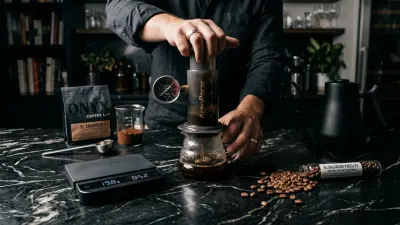
Consistency requires tools that eliminate variables. Achieving reproducible results requires a digital scale reading to 0.1 grams, a premium burr grinder, and a temperature-controlled gooseneck kettle. Blade grinders tear beans into wildly uneven particles, leading to simultaneous over-extraction and under-extraction. A high-quality manual or electric burr grinder from brands like Baratza, Fellow, or Timemore keeps particle size uniform.
- Digital Coffee Scale: Measures coffee bed weight and water flow rate simultaneously.
- Burr Grinder: Conical or flat burrs set to a uniform medium-fine setting.
- Gooseneck Kettle: Allows precise control over water velocity, pour pattern, and bloom agitation.
- Fresh Whole-Bean Coffee: Freshly roasted within 2 to 4 weeks of use for peak gas release and flavor.
To execute a flawless single-cup pour over using an 18-gram coffee dose and a 1:16 ratio (288 g total water):
- Rinse your paper filter with hot water to remove paper taste and preheat your dripper and server; discard the rinse water.
- Add 18.0 grams of freshly ground coffee, tap the sides of the brewer to level the bed, and tare your scale to zero.
- Start your timer and pour 50 grams of water heated to 93 °C (200 °F) in smooth concentric circles to start the bloom; allow it to degas for 45 seconds.
- Pour water in steady concentric pours until reaching 180 grams by 1:15, then complete your final pour to 288 grams by 2:00.
- Give the dripper a gentle swirl to prevent grounds from catching on the filter walls, allowing the water to drain completely by 2:30 to 3:00.
Troubleshooting Taste Profiles and Adjusting Variables
Mastering pour over technique involves adjusting one variable at a time based on taste feedback. If your brewed coffee tastes sharp, sour, or thin, it is likely under-extracted. You can correct this by tightening your ratio (e.g., shifting from 1:17 down to 1:15.5), grinding slightly finer, or increasing water temperature closer to 95 °C to extract more sugars and deep flavors.
Conversely, if your coffee leaves a drying, astringent, or unpleasantly bitter sensation on the back of your tongue, over-extraction has occurred. Increase your ratio (shifting from 1:15 up to 1:17), coarsen your grind, or drop your water temperature slightly. Keeping detailed brew notes regarding your ratio, dose, and water temperature will drastically speed up your learning curve.
Always remember that fresh beans off-gas significant amounts of carbon dioxide during the first week post-roast. If brewing beans under 7 days old, extend your bloom phase up to 60 seconds and consider adding 5% more water to your bloom pour. This step ensures water reaches the interior structure of the grounds, maintaining consistent extraction throughout your chosen ratio.
For consistent success, choose a versatile setup such as a medium-light roast Ethiopian or South American coffee, a conical or flat-bottom dripper, a reliable burr grinder, and stick firmly to a 1:16 ratio with 93 °C water. Keep these core parameters fixed while altering only your grind size to dial in exceptional sweetness and clarity in every single cup.
Frequently Asked Questions
Does pour over coffee need a different ratio than French press?
Yes. French press uses full-immersion brewing where grounds remain in contact with water for 4 minutes, typically favoring a 1:14 to 1:15 ratio. Pour over uses percolation where fresh water constantly passes through the bed, which works best at slightly wider ratios like 1:15 to 1:17.
Can I measure coffee with tablespoons instead of a scale?
While possible, volumetric measurements are highly inconsistent. One level tablespoon of whole coffee beans can weigh between 4 and 7 grams depending on roast level and bean size. Using an inexpensive digital scale measuring in 0.1 g increments eliminates this variance completely.
Should I change my ratio when brewing darker roasts?
Yes, dark roasts are more soluble and porous than light roasts due to longer heat exposure. Using a lower water temperature (88–91 °C) and a slightly tighter ratio like 1:15 prevents extracting harsh, bitter, or burnt flavors from dark roasted coffee beans.