Quick answer: Master advanced Aeropress brewing by shifting from standard immersion to precise variables like bypass dilution, inverted methods, and targeted water temperatures between 85°C and 95°C. Utilizing exact coffee-to-water ratios from 1:4 (concentrate) to 1:16 (filter-style) alongside controlled agitation allows you to dial in specific flavor profiles from high-density roasts to delicate light-roast single origins.
The Physics of AeroPress Extraction: Beyond the Scoop
To truly master the Aeropress, one must understand how pneumatic pressure and full-immersion dynamics interact with coffee solubles. Unlike drip methods like the Hario V60 or Chemex, which rely purely on gravity and percolation, the Aeropress combines total immersion with pressurized percolation. When you push the plunger down, you generate roughly 0.35 to 0.75 bar of pressure. While this is significantly lower than the 9 bars required for real espresso, it is enough to push fine particles through the paper membrane and extract compounds that simple gravity brewing leaves behind.
Extraction yield measures how much of the original dry coffee weight dissolves into the final cup, with the specialty coffee association (SCA) defining the optimal zone between 18% and 22%. Achieving this sweet spot requires fine-tuning variables like particle size distribution and water chemistry. For instance, using a fine grind around 300 to 500 microns increases the total surface area, allowing high extraction yields even at lower water temperatures like 85°C (185°F). Conversely, higher brewing temperatures around 94°C (201°F) accelerate the solubility of floral and malic acidity, but risk pulling out harsh chlorogenic acids if steeping lasts too long.
Water quality plays a silent yet critical role in this physical process. Water containing 75 to 150 ppm (parts per million) total dissolved solids (TDS) with a balanced calcium-to-magnesium ratio acts as a magnet for favorable flavor precursors. If your water lacks minerals, your brew will taste flat and aggressive regardless of your technique. By pairing clean, mineralized water with digital scale measurements, you eliminate variables and gain total authority over the extraction outcome.
Barista's tip: Pay close attention to your press speed and avoid forcing the plunger down when encountering heavy resistance. Pushing too hard causes uneven channel flow around the coffee bed edge, forcing fines through the seal perimeter and over-extracting bitter astringent compounds. Aim for a gentle, constant downward weight using just your forearm—it should take a full 30 to 40 seconds to complete the press, stopping the moment you hear the first hiss of air.
Advanced Recipe Frameworks for Every Roast Profile
Different coffee roasts require vastly different extraction strategies due to changes in bean density and cell structure caused by the roasting process. Light roasts from origins like Ethiopia or Kenya feature high bean density and dense organic acids, requiring higher water temperatures and finer grinds to fully yield their complex notes. Heavy, dark roasts feature fragile cell walls that solubilize rapidly, making them prone to over-extraction if subjected to excessively hot water or long immersion times.
The recipes below utilize specialized techniques, including the inverted method—where the brewer is assembled upside down to eliminate premature dripping—and bypass brewing, where a concentrated extract is diluted with clean hot water to maintain incredible clarity of flavor.
| Recipe Style | Dose (g) | Grind Size (Microns) | Water Temp | Ratio | Target Notes |
|---|---|---|---|---|---|
| Espresso-Style Concentrate | 18.5g | Fine (350–450 µm) | 88°C / 190°F | 1:4.3 (80g water) | Heavy body, dark chocolate, intense sweetness |
| Full-Bodied Immersion | 16.5g | Medium-Fine (600–700 µm) | 92°C / 198°F | 1:15 (250g water) | Balanced fruit, caramel, silky mouthfeel |
| Aromatic Bypass Brew | 20.0g | Medium (700–850 µm) | 95°C / 203°F | 1:4 concentrate + Dilution | Jasmine floral, bright citrus, tea-like clarity |
1. The High-Density Bypass Brew
Bypass brewing separates the extraction process into two phases: extracting highly sweet and acidic solubles during early immersion, followed by diluting that concentrate with pristine water. This prevents the extraction of late-stage astringent polyphenols and bitter compounds that typically ruin light roasts.
- Dose: 20 grams of light-roast single-origin coffee, ground medium (700–800 microns, similar to coarse sand).
- Setup: Inverted position with two rinsed paper filters to increase filtration clarity.
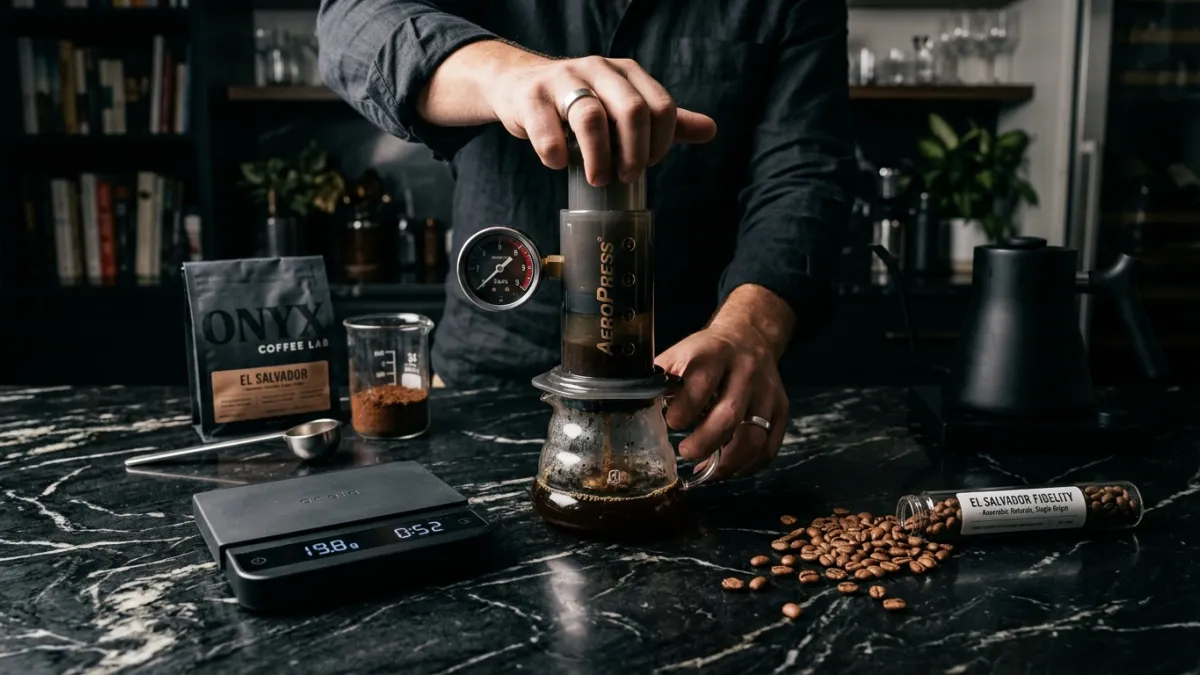
- Pour Phase: Pour 80 grams of water heated to 95°C (203°F) over 10 seconds. Stir vigorously back-and-forth 10 times to break up clumps.
- Steep & Flip: Attach the filter cap, push out excess air, and let steep until the timer hits 1:15. At 1:15, invert onto a decanter and press steadily for 20 seconds.
- Bypass Phase: Add 120 to 140 grams of hot water directly into the decanted concentrate. Swirl gently and let cool to 60°C (140°F) before drinking.
2. The Lower-Temperature Espresso Concentrate
When you crave an intense, syrup-like beverage to enjoy black or mix into a cortado-style milk drink, standard filter ratios fall short. This recipe relies on high dosage and a fine grind on a premium burr grinder, such as a Baratza Virtuoso+ or Fellow Ode, paired with lower temperature water to prevent bitterness.
- Set up your AeroPress in the inverted position and introduce 18.5 grams of finely ground coffee.
- Pour 80 grams of water at 88°C (190°F), saturating all grounds within 5 seconds.
- Stir continuously for 20 seconds to maximize extraction of rich sugars and heavy oils.
- Secure the cap, flip onto a sturdy cup at 45 seconds, and press with steady pressure. Stop immediately when the first air hiss occurs at roughly 1:15.
Fine-Tuning Variables: The Barista’s Dialing-In Guide
Mastering the AeroPress means understanding how subtle variable shifts change cup quality. If your finished cup tastes sour, sharp, or lacks lingering sweetness, under-extraction has occurred. To fix under-extraction, you can refine your grind size finer by 50 microns, increase water temperature by 2°C, or extend total immersion time by 30 seconds. Conversely, if the cup leaves a dry, papery sensation on the back of your tongue accompanied by harsh bitterness, the brew is over-extracted and requires a coarser grind setting or lower water temperature.
Agitation is another critical variable that home baristas often mismanage. Stirring accelerates extraction exponentially by renewing the water boundary layer surrounding each coffee particle. Stirring ten times in ten seconds boosts short-term extraction drastically, allowing you to cut total contact time in half while maintaining high strength. Keep your agitation patterns consistent—use a linear front-to-back motion rather than circular swirling to prevent fine particles from settling in a dense mound at the center of the bed.
Filter choice also changes the tactile experience of the coffee. Standard paper filters remove wood-fiber taste, micro-grounds, and diterpenes (caFestol and kahweol), yielding a cup with exceptional flavor separation and a clean finish. Stainless steel mesh filters allow natural coffee oils and fine insolubles to pass through into the cup, boosting mouthfeel and body similar to a traditional French press.
Advanced Techniques: Water Profiles and Post-Brewing Science
Unlocking world-class flavor requires analyzing the exact composition of the water pouring out of your kettle. Calcium ions (Ca2+) emphasize creamy notes and sweet structures, while magnesium ions (Mg2+) bind effectively to delicate oxygen compounds, bringing out vibrant fruity acids. Tap water high in bicarbonate acts as a buffer that destroys acidity, turning bright Ethiopian coffees flat and dull. Mixing distilled water with specialized mineral packets allows you to pinpoint ideal mineral balances for specialty brewing.
Post-brew cooling dynamics also drastically affect taste perception. Human taste receptors process sweetness and subtle aromatic notes far better between 50°C and 60°C (122°F to 140°F) than at scalding temperatures above 70°C (158°F). Allowing your AeroPress brew to sit for three to four minutes before sipping lowers the kinetic energy of the beverage, revealing intricate floral notes and balanced acidity that remain hidden when the coffee is piping hot.
To maximize clarity when using light roasts, consider employing double paper filtration. Stacking two paper filters increases resistance slightly, slowing down the flow rate and trapping superfine particles that typically slip through a single sheet. This simple modification tightens particle distribution in the cup, giving you a smooth, tea-like body free of grit.
Strategic Recommendation for Home Baristas
If you are looking to take your daily morning routine to the next level, start by acquiring a quality manual or electric burr grinder capable of precise particle control, along with a digital scale accurate to 0.1 grams. Begin your advanced journey using the High-Density Bypass Brew technique paired with a high-grown, washed single-origin light roast at a 1:15 overall ratio. Mastering this approach provides immediate control over clarity and body while teaching you how agitation and water dilution transform your coffee experience.
Frequently Asked Questions
Is the inverted AeroPress method dangerous to perform at home?
The inverted method is safe as long as you exercise basic caution. Ensure the rubber plunger is inserted at least 1.5 cm into the chamber to create a secure air seal before adding water. Avoid filling the chamber to the absolute brim, and firmly secure the filter cap before carefully flipping the device onto a sturdy vessel.
How does paper filter orientation and rinsing affect flavor profile?
Rinsing paper filters with hot water before brewing washes away residual manufacturing paper taste and warms up the filter cap assembly. Pre-heating these components prevents thermal loss during the initial bloom phase, maintaining target slurry temperatures across the extraction window.
Can I make authentic espresso using an AeroPress?
While an AeroPress can create a rich, highly concentrated coffee base suitable for milk drinks, it cannot produce true espresso. Espresso requires 8 to 9 bars of pressure to emulsify coffee oils into a thick crema, whereas an AeroPress maxes out at under 1 bar of human-applied pressure.
Why does my AeroPress plunger require extreme force to press down?
High resistance during pressing usually means your coffee grind size is too fine, creating a compacted filter cake that blocks water passage. Alternatively, your coffee may contain excessive fine particles ("fines") caused by dull grinder burrs. Adjust your grind size coarser until pressing takes a smooth 30 to 40 seconds.
Sources
- Specialty Coffee Association Standards
- Wikipedia: AeroPress Engineering and History
- World AeroPress Championship Official Brewing Archive