The Science Behind Cold Brew Extraction
Before we talk about specific times, it's helpful to understand what's actually happening during the cold brew process. When you immerse coffee grounds in cold water, the extraction of soluble compounds occurs much more slowly and selectively than with hot water. Heat acts as a catalyst, speeding up chemical reactions and dissolving a wide range of compounds quickly. Cold water, however, is a much gentler solvent. This slow, gentle extraction is precisely why cold brew is celebrated for its low acidity and smooth flavor profile. Many of the compounds responsible for bitterness and acidity, particularly quinic and chlorogenic acids, are less soluble in cold water. Over time, however, even these less desirable compounds will eventually be extracted, which is why there's a limit to how long you should steep. The goal is to maximize the extraction of sugars, oils, and other flavor compounds, along with caffeine, while minimizing the harsher elements.Factors Influencing Your Steeping Time
While steeping time is critical, it doesn't operate in a vacuum. Several other variables play a significant role in how quickly and effectively your coffee extracts, and understanding them will help you fine-tune your process even further. Thinking of these as interconnected elements, rather than isolated factors, is key to becoming a true cold brew artisan.Coffee Grind Size
This is arguably the most crucial variable alongside steeping time. For cold brew, a coarse, uniform grind is essential. Think of a coarse grind as having larger surface area particles. This allows for a slower, more even extraction and prevents over-extraction of undesirable compounds, which can happen quickly with finer grinds. If your grind is too fine, you risk a muddy brew, bitterness, and difficulty filtering. Conversely, a grind that's too coarse might lead to under-extraction, resulting in a weak flavor even with extended steeping.Coffee-to-Water Ratio
Your ratio directly impacts the concentration of your final brew. A typical cold brew ratio ranges from 1:4 to 1:8 (coffee grounds to water by weight). A higher coffee-to-water ratio (e.g., 1:4) will yield a stronger concentrate that often requires dilution, allowing for shorter steeping times to achieve a desired strength. A lower ratio (e.g., 1:8) produces a ready-to-drink cold brew that might need longer steeping to develop full flavor, but won't be as intense. Experimentation here is part of the fun.Water Quality
Just like any other brewing method, the quality of your water makes a substantial difference. Filtered water is always recommended, as tap water can contain minerals or chemicals that impart off-flavors or hinder proper extraction. Water that is too hard or too soft can affect the final taste, subtly altering how the coffee's flavors present themselves.Coffee Bean Roast Level and Origin
Different beans extract differently. Lighter roasts tend to be denser and require slightly longer steeping times to fully develop their complex flavors. Darker roasts, having already undergone more extensive thermal processing, are more porous and extract more quickly. Similarly, the origin of your beans can influence steeping. For instance, a bright African single-origin might benefit from a slightly shorter steep to preserve its delicate notes, while a robust Sumatran might handle a longer steep to bring out its earthy richness.The Cold Brew Steeping Time Guide by Desired Strength
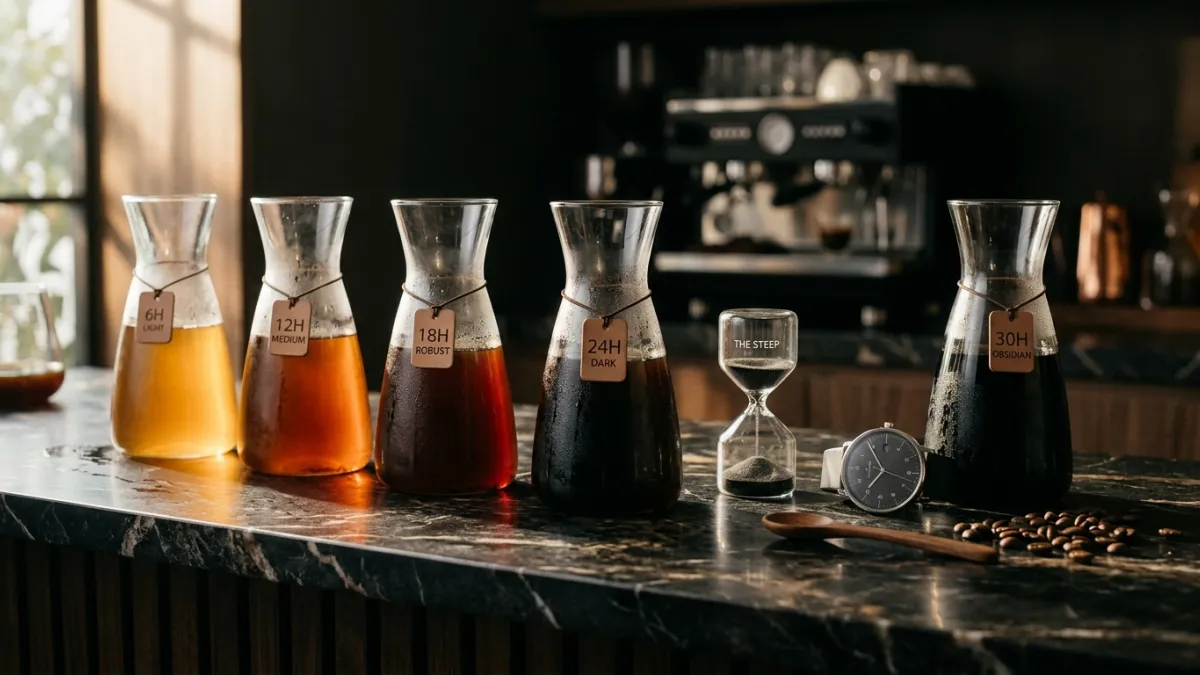
Now for the main event: how long should you steep your cold brew? The answer isn't a single number, but rather a range dictated by the strength and flavor profile you're aiming for. Remember, these are starting points – your personal taste buds are the ultimate judge.Light & Refreshing (12-14 Hours)
If you're looking for a very delicate, easy-drinking cold brew that's smooth and refreshing without being too intense, a shorter steeping time is ideal. This range works well for beans with bright, floral, or fruity notes that you want to preserve. It's often ready-to-drink with minimal or no dilution. Expect a lighter body and a gentle caffeine kick.
- Target Flavor: Mild, delicate, subtle notes.
- Ideal for: Lighter roast single-origins, fruity/floral beans.
- Typical Ratio: 1:7 to 1:8 (coffee to water).
- Outcome: Ready-to-drink, less dilution needed.
Balanced & Smooth (16-18 Hours)
This is the sweet spot for many cold brew enthusiasts, offering a harmonious balance of flavor, body, and smoothness. An overnight steep within this range allows for excellent extraction without venturing into bitter territory. Most medium roast coffees, and even some darker roasts, perform beautifully here, yielding a versatile concentrate that can be enjoyed as-is or diluted slightly.
- Target Flavor: Well-rounded, balanced, noticeable sweetness.
- Ideal for: Most medium to medium-dark roasts, versatile beans.
- Typical Ratio: 1:5 to 1:6 (coffee to water).
- Outcome: Versatile concentrate, often diluted 1:1 with water or milk.
Bold & Intense Concentrate (20-24 Hours)
For those who crave a robust, powerful cold brew concentrate, extending the steeping time to a full 20-24 hours is the way to go. This duration extracts a significant amount of soluble solids, resulting in a very strong, viscous concentrate that stands up well to dilution with ice, water, milk, or even in cocktails. Darker roasts with chocolatey or nutty profiles often shine at this longer duration, but be mindful of potential bitterness with lighter roasts.
- Target Flavor: Rich, strong, full-bodied, deep notes.
- Ideal for: Darker roasts, blends, making a concentrate for dilution.
- Typical Ratio: 1:4 to 1:5 (coffee to water).
- Outcome: Strong concentrate, typically diluted 1:2 or 1:3.
Beyond 24 Hours: When to Stop
While some adventurous brewers might push beyond 24 hours, it's generally not recommended. After a full day of steeping, most of the desirable compounds have been extracted. Further steeping primarily extracts compounds that contribute to bitterness, astringency, and an overall muddy flavor. The marginal gain in strength is usually outweighed by a significant decline in taste quality. Think of it as hitting a point of diminishing returns, where more time actively detracts from the experience.
Here's a quick reference table to summarize the steeping times and expected outcomes:
| Desired Strength | Steeping Time | Recommended Grind | Typical Ratio (Coffee:Water) | Flavor Profile |
|---|---|---|---|---|
| Light & Refreshing | 12-14 hours | Coarse | 1:7 - 1:8 | Mild, delicate, subtle, bright |
| Balanced & Smooth | 16-18 hours | Coarse | 1:5 - 1:6 | Well-rounded, harmonious, sweet notes |
| Bold & Intense Concentrate | 20-24 hours | Coarse | 1:4 - 1:5 | Rich, strong, full-bodied, deep |
Tips for Perfecting Your Cold Brew Steeping
Achieving consistently great cold brew is all about attention to detail and a willingness to experiment. Here are a few practical tips to elevate your brewing game and ensure every batch is a winner. Remember, your kitchen is your laboratory, and you are the head scientist.Start with Quality Beans
This might seem obvious, but it bears repeating. Even the most perfectly timed steep won't rescue poor-quality or stale beans. Invest in freshly roasted, whole beans and grind them just before brewing for the best results. The difference is truly astounding.
Grind Your Own Coffee
A burr grinder is a cold brew essential. Pre-ground coffee is usually too fine for cold brew, and blade grinders produce an inconsistent grind. A consistent, coarse grind ensures even extraction and prevents over-extraction and sludge.
Use a Reliable Container and Filter
Any large jar or pitcher will work, but dedicated cold brew makers with built-in filters simplify the process. For filtering, use a fine-mesh sieve lined with cheesecloth or a dedicated cold brew filter. Some even use paper filters (like Chemex or pour-over filters) after an initial coarse strain for an ultra-clean cup.
Store Properly
Once your cold brew is steeped and filtered, transfer it to an airtight container and store it in the refrigerator. Cold brew can last for up to two weeks, though its peak freshness is typically within the first week. The longer it sits, the more its flavor profile can degrade, even in the fridge.
Taste and Adjust
The most important tip of all: taste your cold brew! Take notes on your ratios, grind size, steeping time, and the resulting flavor. Did you like it? Was it too strong? Too weak? A little bitter? Use this feedback to tweak your next batch. That's how you truly master the craft and dial in your personal perfect cup.
Mastering the steeping time for cold brew transforms it from a simple coffee drink into a nuanced art form. By understanding the principles of extraction and the influence of various factors, you gain the power to consistently craft a cold brew that perfectly matches your preferences. So go ahead, experiment with these guidelines, and turn your home into the ultimate cold brew destination. Your ideal cup awaits!