Walking into a specialty café often entices the senses with complex aromas ranging from buttery caramel lattes to rich, aromatic vanilla flat whites. While specialty espresso shots provide a foundation of dark chocolate, berry, or stone fruit notes, custom-crafted flavoring syrups elevate everyday home brews into artisan coffee beverages. Crafting your own sweet additions at home gives you complete authority over sugar concentration, ingredient purity, and flavor intensity. Beyond superior taste, eliminating artificial preservatives, high-fructose corn syrups, and synthetic dyes allows the natural characteristics of your specialty beans to shine without being overwhelmed by chemical sweetness.
Quick answer: Making custom coffee syrups requires simmering equal parts water and sugar until dissolved, creating a 1:1 simple syrup base that easily integrates into both hot espresso and cold brew drinks. Infusing high-grade real vanilla pods, dark brown sugars, or toasted nuts during or after heating yields café-quality flavor profiles without artificial preservatives. Stored in airtight glass bottles under refrigeration, standard 1:1 syrups remain fresh for two to three weeks, while concentrated 2:1 rich syrups stay fresh for up to two months.
The Science and Economics of Homemade Flavor Syrups
Commercial syrup bottles found on grocery store shelves often rely heavily on sodium benzoate, potassium sorbate, and artificial flavor compounds designed for long-term stability rather than culinary excellence. When heated milk and hot espresso interact with low-grade artificial syrups, the high acidity can cause subtle off-flavors or synthetic chemical aftertastes. Preparing syrup in your own kitchen preserves organic aromatic compounds, allowing authentic spices, extracts, and real sugars to harmonize naturally with coffee oils.
From a financial perspective, crafting syrup at home offers incredible savings for daily coffee drinkers. A standard 750 mL bottle of commercial specialty coffee syrup costs between $12 and $16, whereas making an equivalent volume of pure cane sugar syrup costs less than $1.50 in raw ingredients. Investing that saved capital back into freshly roasted specialty beans (roasted within 2 to 4 weeks) yields a dramatically higher upgrade to your morning routine than buying mass-produced flavor additives.
Understanding the chemistry of sugar dissolution is equally fundamental to achieving proper mouthfeel and extraction balance. Granulated sucrose dissolves seamlessly into water when heated to roughly 70 °C (158 °F), forming stable hydrogen bonds that prevent crystallization when chilled. Incorporating liquid syrups rather than raw granulated sugar into cold brew or iced espresso ensures instant dispersion, eliminating grainy residue at the bottom of your glassware.
Mastering the Foundation: 1:1 vs. 2:1 Syrup Ratios
Every exceptional flavored syrup relies on a stable simple syrup foundation. The primary decision when formulating your base centers on selecting between a standard simple syrup (1:1 ratio) and a rich simple syrup (2:1 ratio). Each variation serves a distinct functional purpose depending on whether you are preparing delicate pour-over iced coffees, milk-based lattes, or concentrated espresso lattes.
A standard 1:1 ratio (equal weight of water and sugar) measures roughly 50 degrees Brix (percent sugar by weight). It flows freely, mixes effortlessly with chilled liquids, and adds sweetness without significantly altering the viscosity of the drink. Conversely, a 2:1 rich simple syrup achieves approximately 66 degrees Brix. This higher sugar concentration creates a luxuriously thick texture, reduces water dilution in your milk drinks, and acts as a natural preservative by lowering water activity to hinder bacterial growth.
| Syrup Base Type | Sugar-to-Water Ratio | Approximate Brix Level | Refrigerated Shelf Life | Best Coffee Application |
|---|---|---|---|---|
| Standard Simple Syrup | 1:1 (e.g., 200 g sugar / 200 g water) | 50° Brix | 2–3 Weeks | Iced Coffees, Cold Brew, V60 Pour-Overs |
| Rich Simple Syrup | 2:1 (e.g., 400 g sugar / 200 g water) | 66° Brix | 6–8 Weeks | Hot Lattes, Cappuccinos, Espresso Shots |
| Demerara / Turbinado Syrup | 1:1 or 2:1 Raw Sugar Base | 50°–66° Brix | 3–4 Weeks | Dark Roast Espresso, Cortados, Warm Brews |
How to Make a Flawless Standard Simple Syrup Base
To prepare a professional 1:1 simple syrup base, always utilize a digital kitchen scale for precision rather than volumetric measuring cups. Combine 200 grams of filtered water and 200 grams of refined white granulated sugar or organic cane sugar in a small stainless steel saucepan. Filtered water prevents tap water minerals or chlorine from contaminating delicate floral coffee notes.
Place the saucepan over medium heat and stir constantly with a silicone spatula until the liquid turns completely crystal clear. Bring the mixture to a gentle simmer (around 85–90 °C), but avoid prolonged boiling, which evaporates water content and alters your targeted Brix ratio. Remove the pan from heat immediately once the sugar dissolves, allow it to cool to room temperature, and bottle it in a sterilized glass container.
Artisanal Syrup Recipes for Home Baristas
Once you master the base simple syrup recipe, transforming it into signature café flavors involves careful heat control and high-grade aromatic ingredients. Volatile organic compounds in pure extracts and natural spices break down if exposed to excessive boiling temperatures, so timing your flavor additions is crucial to capturing vibrant flavor profiles.
Real Madagascar Vanilla Bean Syrup
Unlike commercial vanilla syrups that rely on synthetic vanillin, true vanilla syrup uses whole vanilla beans combined with pure extract to provide complex floral and woody notes that enhance smooth espresso blends.
- 200 g filtered water
- 200 g organic granulated cane sugar
- 1 whole Madagascar or Tahitian vanilla bean (split open lengthwise)
- 1 teaspoon (5 mL) high-grade pure vanilla extract
Combine water, sugar, and the scraped seeds plus the split pod of the vanilla bean in a saucepan. Warm over medium heat for 5 minutes until fully dissolved, then lower heat to low and let steep for 20 minutes without boiling. Remove from heat, stir in the pure vanilla extract after the syrup cools below 50 °C (122 °F) to protect aromatic compounds, strain out the pod fragments, and chill.
Barista's tip: Never add alcohol-based pure extracts to boiling syrup on an active burner. High temperatures flash off the subtle aromatic esters, leaving behind flat sweetness. Always wait until your hot syrup lowers to around 40–50 °C before folding in delicate extracts or citrus zest.
Rich Salted Caramel Coffee Syrup
True caramelization requires taking pure sugar through thermal decomposition, converting simple sucrose into complex, buttery caramel compounds with deep copper hues.
Measure 200 grams of granulated white sugar and 50 grams of water into a clean, heavy-bottomed saucepan. Heat over medium-high heat without stirring; instead, gently swirl the pan occasionally to promote even caramelization. Watch closely as the sugar bubbles transition from clear to light amber, and finally into a rich, deep copper color at approximately 170–180 °C (338–356 °F).
Immediately remove the pan from heat and carefully pour in 120 grams of warm filtered water along with 1/2 teaspoon of coarse flaky sea salt. The mixture will bubble violently as steam releases, so exercise caution. Whisk continuously over very low heat until the hardened caramel re-dissoves smoothly into a silk-like liquid syrup, then cool thoroughly before bottling.
Toasted Roasted Hazelnut Syrup
To achieve an authentic hazelnut profile without artificial oils, raw nuts must undergo a dry roast to release their fragrant lipids before steeping in sweet syrup.
Spread 100 grams of raw, unsalted peeled hazelnuts on a baking sheet and roast at 180 °C (350 °F) for 8 to 10 minutes until golden and highly aromatic. Roughly crush the warm roasted nuts with a rolling pin and add them directly into a simmering 1:1 simple syrup base (200 g water, 200 g brown sugar). Reduce heat to absolute minimum, cover with a tight lid, and steep for 45 minutes. Strain through a fine mesh sieve lined with cheesecloth to remove all solid nut particles and oils before bottling.
Integrating Syrups into Specialty Coffee Brewing Ratios
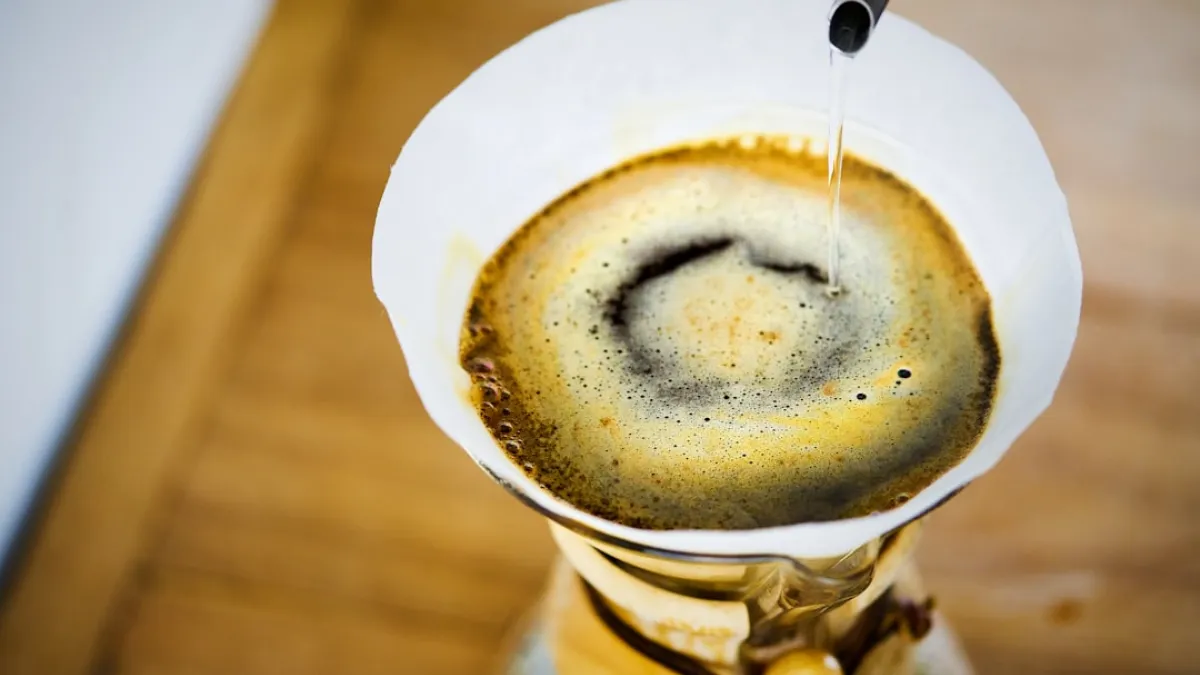
Adding custom syrups into specialty coffee drinks requires maintaining proper extraction balances so the syrup enhances rather than smothers the natural coffee bean profile. Standard specialty coffee brewing relies on precise coffee-to-water ratios ranging between 1:15 and 1:17 for pour-over methods like the Hario V60 or Fellow Stagg, and 1:2 for traditional double espresso extractions (e.g., 18 grams in to yield 36 grams out in 25 to 30 seconds).
When crafting milk-based drinks like lattes or cappuccinos, steam fresh whole milk or oat milk to 60–65 °C (140–150 °F) to preserve microfoam sweetness. Add approximately 15 to 20 mL (0.5 to 0.75 oz) of custom syrup directly into your hot espresso shot before pouring milk. Stirring the syrup directly into the 90–96 °C espresso ensures complete dissolution and even distribution throughout the drink's microfoam layer, maintaining consistent flavor from the first sip to the last.
For iced drinks and cold brew coffee (typically steeped at a 1:8 concentrate ratio for 16 to 20 hours and diluted 1:1 over ice), syrup dosage can be slightly increased to 25 mL to compensate for how lower temperatures temporarily suppress human taste bud sensitivity to sweetness. Using a lighter 1:1 simple syrup base ensures instant solubility in cold liquids without needing manual agitation or vigorous shaking.
Storage, Sanitation, and Shelf-Life Guidelines
Because homemade coffee syrups contain no synthetic chemical preservatives, proper sanitation is mandatory to prevent mold development or yeast fermentation over time. Always sanitize glass storage bottles, pump dispensers, and funnel tools with boiling water or a food-safe sanitation solution prior to filling.
Store all completed syrups in airtight glass bottles inside a refrigerator set to 4 °C (39 °F) or lower. Adding a single tablespoon (15 mL) of high-proof neutral spirit (such as vodka) to a cooled 500 mL batch acts as a natural antimicrobial agent, extending standard shelf life by two to three additional weeks without altering taste profiles. If you observe any cloudiness, off-odors, or sediment formation, discard the batch immediately and prepare a fresh run.
To maximize your home café experience, prepare a versatile 2:1 rich cane sugar syrup base first, keep it stored in a sanitized glass squeeze bottle in your refrigerator, and experiment by adding small drops of natural extracts, cinnamon sticks, or sea salt directly into individual coffee mugs based on your morning mood.
Frequently Asked Questions
Why is my homemade coffee syrup crystallizing in the refrigerator?
Crystallization occurs when sugar molecules re-bind together, usually caused by over-boiling the liquid or having undissolved sugar crystals on the pan walls during cooking. Adding a drop of lemon juice, a teaspoon of corn syrup, or a pinch of cream of tartar introduces glucose and fructose, which prevents sucrose molecules from forming crystals.
Can I make sugar-free homemade coffee syrups for keto or low-calorie diets?
Yes, natural non-nutritive sweeteners like pure erythritol, monk fruit extract, or allulose can replace traditional sugar. Allulose is particularly recommended because it dissolves cleanly, caramelizes similarly to real sucrose, and does not re-crystallize when stored in the refrigerator like erythritol often does.
How much homemade syrup should I add to a standard 12-ounce latte?
A standard café-style 12-ounce latte typically utilizes 1 to 1.5 fluid ounces (30 to 45 mL) of sweet syrup, which equates to roughly 2 to 3 tablespoons. If you prefer a coffee-forward drink where bean origin flavors remain prominent, start with 0.5 fluid ounces (15 mL or 1 tablespoon) and adjust upward to taste.
Should I store my homemade coffee syrups on the counter or in the fridge?
While high-sugar commercial syrups contain chemical preservatives that allow shelf storage, homemade 1:1 syrups should always be kept refrigerated to prevent spoilage. Rich 2:1 syrups can sit at room temperature for short periods, but refrigeration guarantees maximum freshness and safety for up to two months.