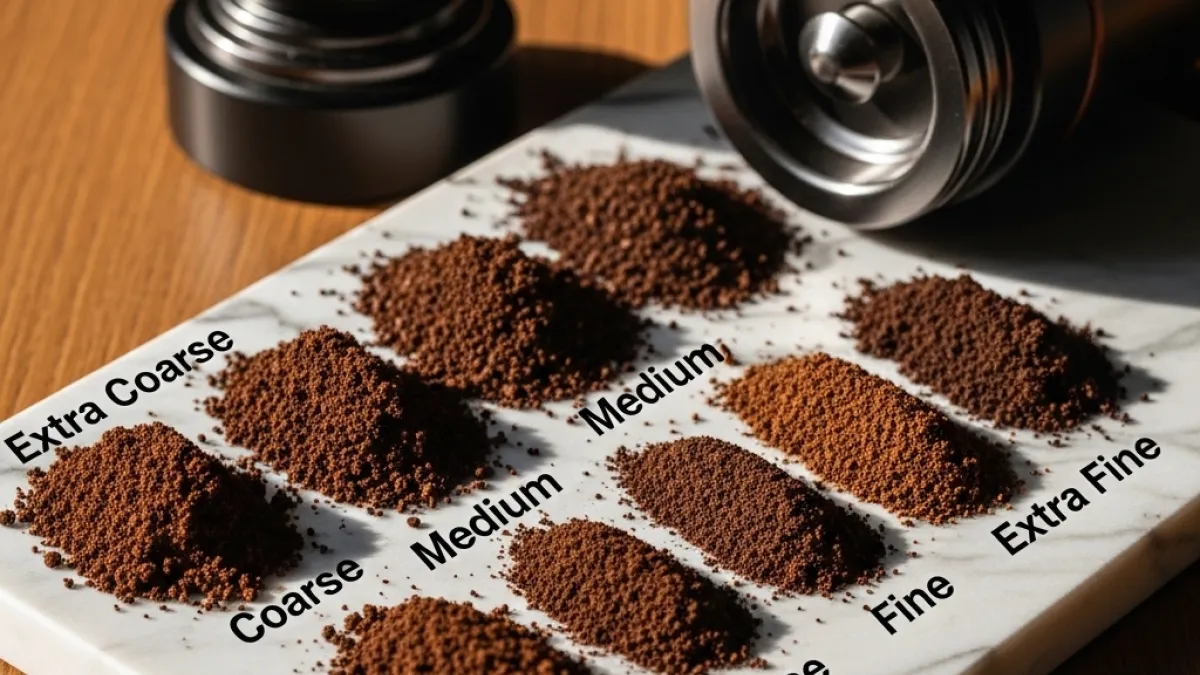
Quick answer: To achieve ideal coffee extraction, your grind size must match your brewing time: use extra-fine (under 200 microns) for Turkish coffee, fine (200–400 microns) for espresso, medium-fine (400–600 microns) for pour-over, medium (600–800 microns) for drip machines, and coarse (800–1200+ microns) for French press and cold brew.
The Physics of Extraction: How Particle Size Shapes Flavor
Every coffee bean contains roughly 30% soluble material, but extracting all 30% results in a bitter, unpalatable brew. The specialty coffee association (SCA) establishes that the sweet spot for coffee extraction lies between 18% and 22% total dissolved solids (TDS) yield. Achieving this ideal window depends almost entirely on surface area contact time. When coffee beans are ground into smaller particles, their exposed surface area increases exponentially. Consequently, smaller grounds release their soluble compounds rapidly when exposed to hot water, whereas larger particles require significantly more contact time for water to penetrate into their centers.
When coffee is under-extracted, water dissolves the easily accessible acids and salts first, leaving behind the rich sugars and deeper aromatics. This results in a shot or pour-over that tastes thin, sharply sour, and unpleasantly quick to finish. Conversely, over-extraction occurs when water remains in contact with small particles for too long, stripping away heavy polyphenols and astringent tannins. This leaves a lingering, dry, burnt bitterness on the back of your tongue. Finding the exact balance requires pairing precise water temperature—ideally between 90°C and 96°C (195°F–205°F)—with a matched grind profile and brew timing.
Water quality and coffee freshness also interact heavily with your grind setting. Freshly roasted coffee (best consumed 2 to 4 weeks post-roast date) off-gasses carbon dioxide, which creates resistance against incoming brew water during the initial bloom stage. Using an 18 gram dose with a 1:15 to 1:17 coffee-to-water ratio gives you a stable baseline to measure flow rate and flavor clarity. If your coffee flows too fast or stalls during extraction, adjusting your particle size by small increments is the most reliable way to bring the cup back into harmony.
The Complete Coffee Grind Size Breakdown
Navigating grind settings can feel overwhelming, but categorizing particle sizes by visual textures, physical feel, and target micron ranges simplifies the process. Below is the definitive guide to matching particle size with your favorite coffee guides and brewing equipment.
| Grind Level | Micron Range | Visual / Tactile Texture | Ideal Brew Method | Target Brew Time |
|---|---|---|---|---|
| Extra-Fine | < 200 µm | Powdered sugar, flour-like | Turkish Coffee (Cezve) | 2 – 3 minutes |
| Fine | 200 – 400 µm | Table salt, finely granulated | Espresso, Moka Pot | 25 – 30 seconds |
| Medium-Fine | 400 – 600 µm | Gritty sand, beach sand | Hario V60, AeroPress | 2:30 – 3:30 minutes |
| Medium | 600 – 800 µm | Coarse sand, kosher salt | drip coffee maker, Siphon | 4 – 5 minutes |
| Medium-Coarse | 800 – 1000 µm | Rough sea salt, steel-cut oats | Chemex, Clever Dripper | 3:30 – 4:30 minutes |
| Coarse | 1000 – 1200 µm | Coarse rock salt, potting soil | French Press, Percolator | 4 minutes (immersion) |
| Extra-Coarse | > 1200 µm | Cracked peppercorns, wood shavings | Cold Brew, Toddy System | 12 – 24 hours (steep) |
1. Extra-Fine Grind (< 200 Microns)
Extra-fine coffee feels completely smooth between your fingers, similar to baking flour or powdered sugar. Because the particles are so minute, they offering virtually no resistance to water without forming a dense paste. This setting is strictly reserved for Turkish coffee prepared in a traditional copper cezve. The ultra-fine particles suspend directly in boiling water, creating an intensely concentrated, unfiltered cup with a velvety texture.
2. Fine Grind (200 – 400 Microns)
A fine grind closely resembles fine table salt. When rubbed between thumb and forefinger, it feels gritty but noticeable clumps will form under light pressure. This is the gold standard for espresso extraction, where commercial or high-end home pumps push 9 bars of pressure through an 18g coffee puck. The fine surface area ensures water dissolves compounds evenly during a brief 25 to 30 second shot window. It is also suitable for traditional stovetop Moka pots and rapid AeroPress recipes.
3. Medium-Fine Grind (400 – 600 Microns)
Slightly finer than standard beach sand, medium-fine grounds offer exceptional clarity for pour-over devices such as the Hario V60 or Kalita Wave. Water drains through filter paper at a steady, controlled rate, allowing a total drawdown time of roughly 2:30 to 3:30. If your pour-over stalls and pools at the top, your grind is creeping too close to fine; if water runs straight through under two minutes, adjust your grinder finer.
Barista's tip: When dialing in espresso or dense manual pour-overs, beware of micro-channelling caused by inconsistent particle sizes. If your burr grinder generates excessive fine particles ("fines"), water will find the path of least resistance through cracks in the coffee bed. To prevent uneven extraction, stir your grounds with a distribution tool (WDT) before tamping, and maintain your burr set by cleaning residual coffee oils monthly.
4. Medium Grind (600 – 800 Microns)
Medium coffee grounds look and feel like standard kosher table salt or gritty sand. This versatile setting is the default profile for standard auto-drip machines, flat-bottom basket brewers, and vacuum siphon pots. The particle structure balances flow resistance and immersion time, keeping the coffee bed saturated for a balanced four-to-five-minute cycle without clogging machine basket valves.
5. Medium-Coarse to Coarse Grind (800 – 1200+ Microns)
Ranging from rough sea salt to cracked peppercorns, coarse settings are designed for long immersion methods like the French Press and long-steep Cold Brew. Because thick paper filters are omitted in a French press, large particles prevent fine sediment from passing through the metal mesh filter into your mug. For cold brew, an extra-coarse particle size permits a slow 12 to 24-hour steeping period in room-temperature water without turning the concentrate bitter or muddy.
Blade vs. Burr Grinders: Why Particle Consistency Matters
Investing in exceptional coffee beans means very little if you crush them unevenly. Blade grinders operate like small food processors, slicing coffee beans randomly with spinning metal blades. This creates a chaotic mix of heavy chunks (which under-extract) and microscopic dust (which over-extracts), leading to a cup that is simultaneously sour and bitter. A uniform particle size distribution is physically impossible to achieve with a high-speed spinning blade.
Burr grinders, on the other hand, crush coffee beans between two revolving abrasive surfaces at controlled distances. Conical burr grinders use a cone-shaped inner burr inside an outer ring, making them quiet, energy-efficient, and popular in high-end home units like the Baratza Encore or Fellow Ode. Flat burr grinders utilize two parallel rings, which force coffee through uniform gaps via centrifugal force, offering supreme particle uniformity favored by commercial cafés. Utilizing quality flat or conical burrs ensures predictable flow dynamics across every brewing technique.
- Blade Grinders: Inconsistent particle size, heat generation from fast friction, high fines production.
- Conical Burr Grinders: Highly consistent, quiet operation, excellent balance of sweetness and body.
- Flat Burr Grinders: Maximum particle uniformity, exceptionally clear flavor separation, ideal for light roasts.
Troubleshooting Your Extraction: How to Dial In at Home
Every coffee bean has distinct physical properties; high-altitude light roasts are dense and hard, requiring slightly finer adjustments, whereas dark roasts are porous and fragile, fragmenting easily into fine dust. Relying solely on numerical grinder dials can be misleading across different bean origins or ambient humidity levels. Instead, evaluate the final taste of your brew and adjust systematically based on flavor sensory cues.
If your cup tastes intensely astringent, dry, or overwhelmingly bitter, your extraction yield is too high. Shift your grinder 1 to 2 micro-clicks coarser to speed up water flow and reduce contact time. Conversely, if your cup lacks sweetness, tastes sharp, thin, or excessively vegetable-like, your extraction is lagging. Shift your grinder finer to increase surface area contact. Keeping a daily brew log detailing dose, liquid yield, brew time, and grind setting will help you master dialing in new roasts within two to three attempts.
To master manual brewing at home, start by pairing a reliable entry-level conical burr grinder with a simple pour-over cone or French press. Maintain a strict 1:16 coffee-to-water ratio using filtered water at 93°C (200°F), keep your grind size matched to your device specifications, and make single micro-adjustments only when flavor dictates a change.
Frequently Asked Questions
Why does my coffee taste bitter even when using expensive beans?
Bitterness is usually a sign of over-extraction caused by a grind size that is too fine for your brewing method, or water that is too hot. When coffee particles are too small, water extracts bitter tannins and polyphenols; try shifting your grinder to a coarser setting.
Can I use the same grind setting for V60 and Chemex?
Generally, a Chemex requires a slightly coarser grind (medium-coarse) than a Hario V60 (medium-fine). This is because Chemex uses significantly thicker filter paper, which slows water flow; a slightly coarser particle size prevents excessive drawdown times and over-extraction.
How often should I adjust my grind size as my beans age?
As coffee beans age and lose carbon dioxide, water penetrates them more easily. To maintain consistent flow rates and extraction times, you will typically need to adjust your grinder slightly finer every few days as your beans move past two weeks post-roast date.
Sources
- Specialty Coffee Association (SCA) Standards
- Wikipedia: Coffee Extraction Dynamics
- Baratza Grinder Calibration Specifications