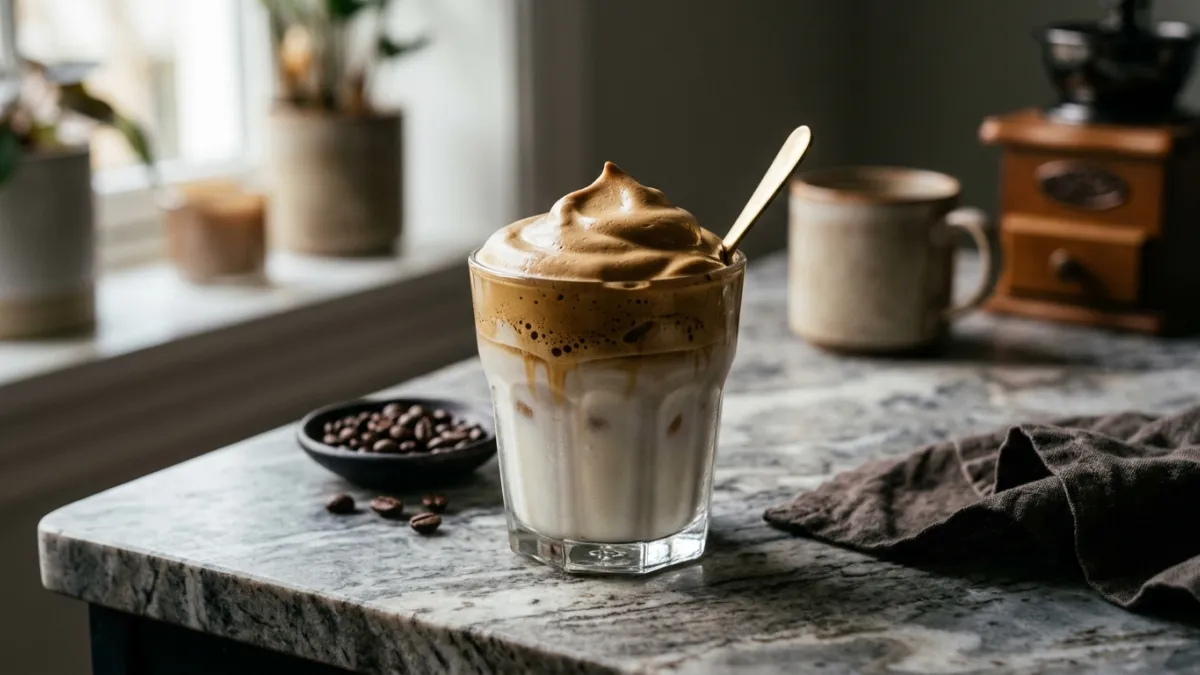
Dalgona coffee transformed home brewing almost overnight, turning a humble tin of instant coffee into a luxurious, dessert-like café drink. Originally popularized in South Korea and rooted in Asian hand-beaten coffee traditions, this velvet-textured whipped beverage balances rich bitter coffee notes with sweet creaminess. Beyond its eye-catching appearance, understanding how instant coffee transforms into a stable, mousse-like foam requires a mix of simple culinary technique and fascinating food science. Whether you are seeking a quick morning pick-me-up or aiming to elevate your home barista repertoire, mastering this beverage takes only a few pantry staples and a couple of minutes of active preparation.
Quick answer: To make Dalgona coffee, whip equal parts instant coffee, granulated sugar, and hot water (a standard single-serving ratio is 2 tablespoons / 12 grams instant coffee, 2 tablespoons / 24 grams sugar, and 2 tablespoons / 30 mL boiling water at 90–95 °C) using a hand mixer for 2–3 minutes until stiff peaks form, then layer the thick golden foam over 200 mL of chilled milk with ice.
The Origin and Foam Chemistry Behind Whipped Coffee
Although Dalgona coffee gained widespread fame on social media platforms in early 2020, its origins stretch back decades. The drink is conceptually adapted from Macau's traditional "hand-beaten coffee" served at Hon Kee Café, where instant coffee mixture was stirred vigorously by hand hundreds of times to create a creamy top. During a Korean television broadcast, actor Jung Il-woo tried the whipped beverage in Macau and noted that its sweet, caramelized flavor reminded him of dalgona (also known as ppopgi), a nostalgic South Korean honeycomb sugar candy. The name stuck, and coffee lovers around the world began recreating the recipe in their own kitchens.
The magic of Dalgona coffee lies in the surface-active compounds found inside instant coffee. During the commercial manufacturing of instant coffee—whether through spray-drying or freeze-drying—proteins, carbohydrates, and melanoidins become concentrated. When agitated with water, these natural surfactants lower surface tension and trap microscopic air bubbles, forming a foam structure very similar to egg whites in a meringue. Freshly brewed espresso or drip coffee cannot easily replicate this structural stability because their higher water ratio and natural lipids break down surface tension prematurely.
Sugar plays a crucial structural role rather than just providing sweetness. As sugar dissolves into hot water, it drastically increases the liquid's viscosity, thickening the walls surrounding each trapped air pocket. This high viscosity slows down liquid drainage caused by gravity, preventing the foam from collapsing back into a liquid state. A properly aerated coffee emulsion with a balanced sugar-to-water mass ratio can retain its velvety shape over chilled milk for hours without losing volume.
Barista's tip: Always dissolve your instant coffee and sugar in hot water measuring between 90–95 °C (195–205 °F) before you begin whisking. Cold water slows down sugar dissolution and leads to gritty, unstable foam, while boiling water directly out of a rolling boil can scorch delicate spray-dried coffee solids, imparting a harsh, rubbery bitterness to your final layer.
Ingredients, Measuring Ratios, and Equipment Setup
Achieving café-grade Dalgona coffee depends heavily on precise measurement ratios and choosing the right combination of tools. The universally accepted golden ratio for the whipped topping is 1:1:1 by volume. This translates to 2 tablespoons of instant coffee granules, 2 tablespoons of white or brown granulated sugar, and 2 tablespoons of near-boiling water. In mass measurements, this equals approximately 12 grams of instant coffee, 24 grams of sugar, and 30 grams of hot water.
When selecting your instant coffee, 100% pure instant granules or freeze-dried coffee crystals yield the best aeration and cleanest coffee profile. Avoid 3-in-1 instant premixes containing pre-added creamer or milk powder, as dairy fats disrupt bubble formation and prevent the mixture from reaching stiff peaks. For the sugar component, refined white granulated sugar dissolves cleanly and yields the lightest caramel shade, whereas raw cane or dark brown sugar introduces deep molasses notes with a slightly darker amber hue. Non-caloric erythritol or monk fruit sweeteners can form foam, but because they lack the viscous binding properties of real sucrose, the resulting peaks collapse significantly faster.
For the liquid base, 200 mL (roughly 3/4 cup) of milk provides the ideal balance against the intense caffeine concentrate resting on top. Whole dairy milk delivers a rich, velvety body with roughly 3.25% fat content that complements the sharp bitterness of the coffee cream. However, oat milk—particularly barista-edition oat milk with added dipotassium phosphate—acts as an outstanding plant-based alternative due to its creamy texture and natural grain sweetness. Almond and soy milk also work well, provided they are well-chilled to maintain distinct thermal layers when serving ice-cold drinks.
Equipment Comparison for Whipping Coffee
Selecting your whisking device determines not only preparation time but also foam microbubble density and stability. Below is a technical performance comparison between common kitchen tools used for preparing Dalgona foam:
| Whipping Method | Average Prep Time | Physical Effort | Bubble Consistency | Peak Stability |
|---|---|---|---|---|
| Electric Hand Mixer (Dual Beaters) | 2–3 minutes | Very Low | Micro-fine, uniform air pockets | High (Holds shape 3–4 hours) |
| Stand Mixer (Balloon Whisk) | 1–2 minutes | None | Dense, whipped cream structure | Very High (Holds shape 4+ hours) |
| Electric Milk Frother (Wand) | 3–5 minutes | Low | Medium-dense foam | Moderate (Holds shape 1–2 hours) |
| Manual Stainless Steel Balloon Whisk | 8–12 minutes | High (Vigorous hand movement) | Variable bubble sizes | Moderate (Holds shape 1 hour) |
Step-by-Step Dalgona Masterclass
Creating flawless whipped coffee involves a quick, structured sequence that maximizes air entrainment into your sweet coffee syrup. Follow these steps to produce silky, stable peaks every single time:
Step 1: Combine and Dissolve
In a medium stainless steel or glass mixing bowl, combine 2 tablespoons (12 g) of instant coffee granules and 2 tablespoons (24 g) of granulated sugar. Pour in 2 tablespoons (30 mL) of hot water heated to 90–95 °C. Swirl or gently stir with a spoon for 15–20 seconds until the granules and sugar crystals dissolve completely into a dark brown liquid syrup. Ensuring zero undissolved crystals remaining at the bottom guarantees uniform texture across your whip.
Step 2: Aerate to Stiff Peaks
Insert the beaters of your electric hand mixer into the mixture. Start on low speed for 30 seconds to avoid splashing liquid out of the bowl, then increase to medium-high speed. Watch as the color transforms rapidly from dark mahogany to golden tan, eventually becoming a light peanut-butter shade. Continue beating for 2–3 minutes until the volume expands roughly fourfold and forms soft-to-medium peaks. For maximum stability, continue whipping until lifting the beaters leaves firm, glossy peaks that hold their shape without slumping.
Step 3: Base Assembly and Layering
Fill a clear 350 mL (12 oz) glass with 3 to 4 large ice cubes (about 50–60 g of ice). Pour 200 mL of chilled whole milk or barista oat milk into the glass, leaving approximately 3 to 4 cm of headspace at the top. Using a silicone spatula or large tablespoon, scoop the dense coffee foam and spoon it gently over the milk. The high density and fat content of the milk easily supports the lightweight coffee emulsion, creating a distinct, picture-perfect two-layer contrast.
Step 4: Garnish and Serve
Optionally dust the top of your whipped foam with fine cocoa powder, dark chocolate shavings, or a pinch of ground cinnamon. Serve immediately with a long spoon or eco-friendly straw. Remind your guests or yourself to stir the drink thoroughly prior to drinking; sipping pure coffee foam directly yields an overwhelming hit of bitterness and sugar, whereas folding the foam into the cold milk yields a creamy, balanced coffee milkshake texture.
Troubleshooting Common Whipping Failure Points
While Dalgona coffee relies on simple ingredients, minor variations in equipment or ratios can occasionally prevent the foam from setting properly. Understanding how to diagnose foam failures ensures consistent results on every attempt.
- Foam remains watery or flat: This usually happens when ground espresso or coffee grounds are substituted for instant coffee. Ground coffee lacks the concentrated soluble solids and surfactants needed for stabilization. Always verify you are using 100% instant coffee granules or powder.
- Excessive whipping time required: Using a wide, shallow bowl spreads the liquid too thin, preventing mixer blades from fully submerging and incorporating air. Switch to a narrow, high-walled bowl or a deep measuring cup so beaters stay submerged in the liquid.
- Foam deflates rapidly over milk: Skimping on sugar reduces syrup viscosity, causing trapped air bubbles to burst or drain quickly. Keep a minimum 1:1 sugar-to-coffee ratio by volume for optimal structural longevity.
- Bitter or harsh aftertaste: High-roast instant coffees can carry intense pyrazines. Balance sharp bitterness by using non-homogenized whole milk, oat milk, or adding a dash of vanilla extract directly into the milk base prior to assembling.
Frequently Asked Questions
Can I make Dalgona coffee without sugar?
You can whip instant coffee and hot water without sugar, but the foam will be far less dense and will collapse within a few minutes. Sugar provides the necessary viscosity to trap air bubbles and maintain stiff peaks. If you must reduce sugar, lower it by no more than half or accept a lighter, frothier texture that should be consumed immediately.
Can I use brewed espresso instead of instant coffee?
Freshly brewed espresso contains too much water and natural oil, preventing it from forming the thick, meringue-like structure achieved by instant coffee. However, you can dissolve 2 tablespoons of instant espresso powder directly into 2 tablespoons of hot water to get an authentic espresso flavor with perfect whipping capacity.
How long does whipped Dalgona foam stay stable in the fridge?
When made with a full 1:1:1 ratio of sugar, instant coffee, and water, stored foam keeps its shape in a sealed glass container in the refrigerator for up to 24 to 48 hours. You may notice minor liquid separation at the bottom over time, which can easily be re-whisked for 10 seconds before serving.
Can I serve Dalgona coffee hot instead of iced?
Yes, Dalgona foam performs beautifully on hot milk. Simply heat 200 mL of milk to 60–65 °C (140–150 °F) in a mug and spoon the whipped coffee directly on top. The heat gently melts the bottom layer of foam into the warm milk, creating an ultra-rich, cappuccino-style head.
For home brewers seeking a fast, indulgent café beverage without expensive espresso machinery, Dalgona coffee offers an unbeatable combination of simplicity, striking visuals, and sweet coffee flavor. Start with the golden 1:1:1 ratio using standard granulated sugar and quality instant coffee, use an electric hand mixer for effortless stiff peaks, and layer over cold barista oat milk or whole dairy milk for the ultimate home café treat.