Disclosure: As an Amazon Associate, we earn from qualifying purchases.
Brewing a bright, crystalline cup of coffee at home requires more than simply dumping hot water over crushed coffee beans. The Blue Bottle pour over system has gained legendary status across the specialty coffee community because it transforms a delicate culinary craft into a repeatable science. Engineered in collaboration with ceramic artisans and fluid dynamics experts in Japan, the proprietary Blue Bottle dripper is crafted to deliver unmatched sweetness, pristine clarity, and delicate flavor separation. Whether you are using a single-origin Ethiopian coffee with stone-fruit acidity or a rich Latin American roast with chocolate undertones, mastering this custom drip method gives you absolute control over extraction variables.Quick answer: The Blue Bottle pour over utilizes a custom flat-bottom ceramic dripper with internal capillary ridges and a single restrictor hole, paired with custom bamboo paper filters. Brewing the perfect cup requires 22 to 30 grams of medium-fine coffee (resembling coarse sea salt or table salt) brewed with 350 grams of water heated to 195–205°F (90–96°C) over a strict 4-pour schedule lasting 2:30 to 3:30 minutes.
The Engineering and Philosophy Behind the Blue Bottle Dripper
Most standard pour-over devices on the market rely either on wide conical angles like the Hario V60 or steep, multi-hole wedge shapes like the Kalita Wave or Melitta. Blue Bottle took a radically different path by partnering with ceramic specialists in Arita, Japan, to design a dripper focused entirely on uniform bed depth and controlled water velocity. The interior walls feature 40 precisely spaced vertical ridges—often referred to as micro-capillaries—that prevent paper filters from clinging flat against the ceramic surface. This allows air to escape freely during brewing, promoting an even drawdown rate regardless of minor hand-pour variations.
At the base of the vessel lies a single, perfectly calibrated exit aperture. Rather than allowing flow rate to be governed solely by your grind size or pouring speed, the restrictive hole acts as a mechanical governor, maintaining a consistent fluid level inside the brew bed. This geometric design keeps the coffee grounds fully submerged in water, preventing thermal loss and eliminating the dreaded perimeter channeling where water bypasses the bed along the filter paper. Combined with heavy porcelain construction that retains thermal energy during the entire cycle, the dripper ensures an exceptionally stable extraction zone.
Custom Bamboo Filters and Bed Hydrodynamics
Paper selection plays a critical role in coffee clarity, and Blue Bottle's specialized bamboo filters are central to their signature taste profile. Unlike traditional wood-pulp filters that require heavy rinsing to wash away papery tasting compounds, these bamboo-based filters are structural, ultra-thin, and taste-neutral straight out of the box. The micro-pleated structure traps fine coffee micro-particles while allowing delicate aromatic oils and soluble solids to pass cleanly into the cup.
Because the dripper features a flat-bottom bed, ground coffee spreads across a uniform horizontal plane rather than wedging into a tight point. This flat topography ensures that every particle of coffee comes into contact with fresh water at roughly the same depth and time. As a result, you achieve high extraction yields without the localized over-extraction that frequently plagues conical drippers.
The Official Blue Bottle Pour Over Recipe and Pouring Schedule
To replicate the signature taste found in specialty cafes, precision in measurement and timing is absolute. Specialty Coffee Association (SCA) standards recommend a brew ratio between 1:15 and 1:17, but Blue Bottle's standard café recipe frequently leans toward a slightly higher dose to highlight body and floral nuance. For a single serve, use 22 to 30 grams of freshly roasted coffee combined with 350 grams of filtered water. Darker blends typically excel around 22 to 24 grams (yielding roughly a 1:15 ratio), while lighter single-origin coffees shine with 26 to 30 grams to emphasize fruit-forward sweetness.
water temperature must be monitored closely with a digital thermometer or variable-temperature kettle. Target a water temperature between 195°F and 205°F (90°C to 96°C). Lightly roasted beans require hotter water near 203–205°F to dissolve dense, complex sugars, whereas darker roasts yield optimal balance at 195–198°F to prevent excessive bitterness and ashiness.
Engineered for Perfection: The Authentic Blue Bottle Dripper

Barista's tip: Always tare your digital scale before starting the bloom pour, and ensure your gooseneck kettle stream falls perpendicular to the coffee bed from a height of no more than 3 to 4 inches. Pouring from higher distances introduces air bubbles and turbulence, which disrupts the settling coffee bed and leads to erratic drawdown times.
The 4-Pour Timing Schedule
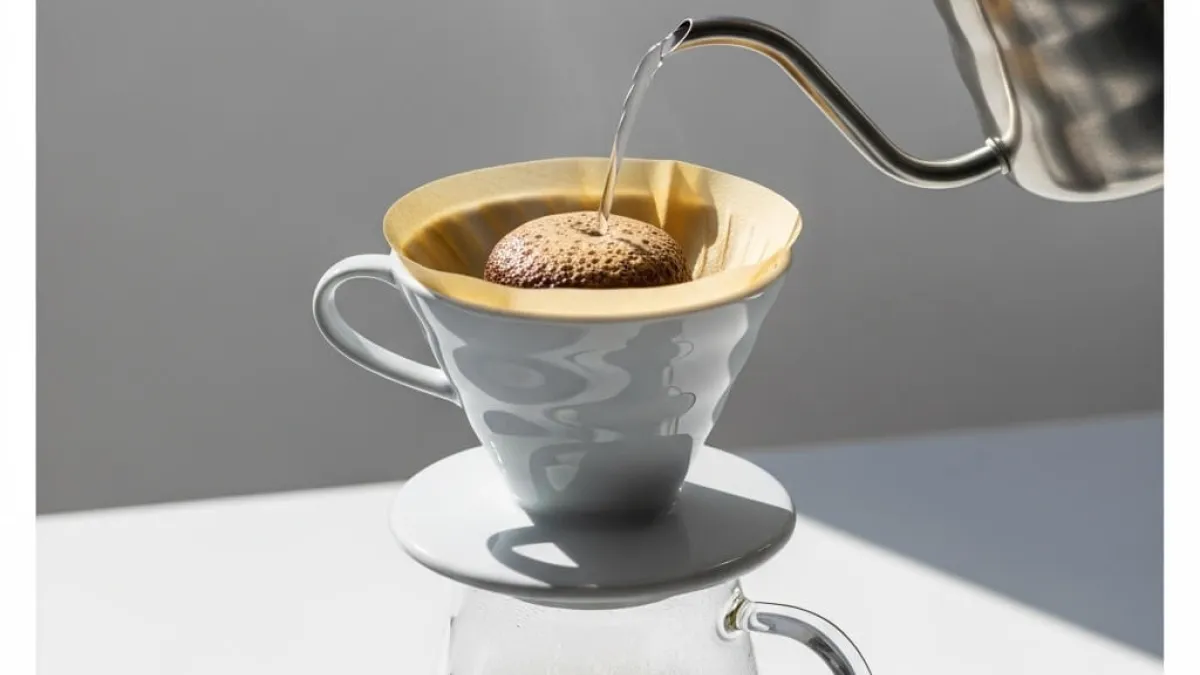
The standard Blue Bottle recipe uses a four-pour pulse technique designed to saturate the coffee bed evenly and maintain an ideal thermal zone throughout the extraction window. Follow this precise pouring schedule using a timer:
- 0:00 – Bloom Pour (60g): Start your timer and gently pour 60 grams of water in outward spiral motions, starting from the center of the grounds and moving toward the edges without hitting the bare paper filter. Allow the coffee to bloom for 40 seconds to release trapped carbon dioxide gas.
- 0:40 – Second Pour (to 150g): Pour steadily in concentric circles until your scale reaches 150 grams total. This pour establishes the main extraction fluid volume and raises the bed temperature.
- 1:10 – Third Pour (to 250g): Add another 100 grams of water in smooth, controlled circles to reach 250 grams total. Keep the stream gentle so you do not gouge holes into the center of the grounds bed.
- 1:40 – Fourth Pour (to 350g): Complete your final pour of 100 grams, bringing the scale weight up to 350 grams. Allow the water to draw down completely through the coffee bed. The total brew time should end between 2:30 and 3:30 minutes.
Grind Size Calibration and Precision Equipment Setup
Proper grind size calibration is the single most crucial factor in avoiding bitter, astringent notes or weak, sour brews. For the Blue Bottle Pour Over dripper, aim for a medium-fine grind size—roughly 500 to 700 microns in diameter, which feels similar to granular table salt or fine beach sand. Because the single bottom hole controls exit velocity, a grind that is slightly too coarse will result in thin, under-extracted coffee, while an overly fine grind will choke the filter and push drawdowns past four minutes.
Using high-quality conical or flat steel burr grinders, such as the Fellow Opus, Baratza Encore ESP, or hand grinders like the Comandante C40, ensures a narrow particle distribution. Blade grinders should be strictly avoided because they produce unpredictable dust (fines) alongside large boulders, leading to simultaneous over-extraction and under-extraction in the same mug.
Equipment Comparison and Specifications
Brew the Cafe Icon: Freshly Roasted Blue Bottle Beans

Choosing the right gear setup ensures consistency across every brew session. The table below outlines key technical specifications for building an ideal home pour-over station:
| Equipment | Recommended Model | Key Feature / Specification | Primary Benefit |
|---|---|---|---|
| Dripper | Blue Bottle Ceramic Dripper | 40 internal capillary ribs, 1 exit hole | Controlled flow rate & thermal stability |
| Filter | Custom Blue Bottle Bamboo Filter | Unbleached, taste-neutral bamboo paper | Clean drawdown without papery taste |
| Grinder | Baratza Encore / Fellow Opus | 40mm steel burrs, 40+ grind settings | Uniform particle size distribution |
| Kettle | Fellow Stagg EKG Gooseneck | 1200W, PID temperature control (135–212°F) | Precise pour-rate and thermal accuracy |
| Scale | Acaia Pearl or Timemore Black Mirror | 0.1g accuracy with built-in timer | Real-time flow monitoring & precise dosing |
Troubleshooting Common Extraction Issues
Even with premium gear, minor errors in technique or water chemistry can alter your cup's final balance. Ideal total dissolved solids (TDS) for pour-over coffee typically range between 1.20% and 1.45%, representing an extraction yield between 18% and 22%. If your coffee tastes unpleasantly sour, grassy, or sharp, your coffee is under-extracted. Increase your water temperature by 2–4°F or adjust your grinder one notch finer to extend contact time.
Conversely, if your coffee leaves a dry, chalky sensation on your tongue or tastes harsh and medicinal, over-extraction has occurred. This indicates that water passed too slowly through the bed or dissolved bitter organic compounds from over-agitation. Coarsen your grind setting slightly or lower your water temperature to restore sweetness and clarity.
Water Composition and Bean Freshness
Since a cup of pour-over coffee is over 98% water, tap water high in calcium carbonate or chlorine will destroy delicate floral aromas. Use filtered or remineralized water with a total dissolved solids level around 75 to 125 ppm, featuring balanced calcium and magnesium ions to extract desirable flavor molecules. Additionally, select beans roasted within 7 to 28 days. Super-fresh beans roasted under 4 days ago off-gas too violently during the bloom stage, while stale beans older than 6 weeks lack the aromatic volatile oils necessary for a crisp, layered cup.
If you want a reliable, café-quality daily ritual without constant guesswork, invest in the authentic ceramic Blue Bottle dripper paired with their bamboo filters and a variable gooseneck kettle. Start with a solid 1:15 ratio using 24 grams of fresh single-origin coffee to 360 grams of water at 202°F, dial in a salt-like medium-fine grind, and follow the 4-pour pulse method to experience pristine balance right from your kitchen counter.
Frequently Asked Questions
What is the ideal grind size for a Blue Bottle pour over?
No Turbulence: The Barista's Precision Gooseneck Kettle

The ideal grind size is medium-fine, resembling table salt or sand. On popular home burr grinders like the Baratza Encore, this typically falls between settings 13 and 16, aiming for a total drawdown brew time between 2:30 and 3:30 minutes.
Can I use standard Kalita Wave or V60 paper filters in a Blue Bottle dripper?
While Kalita Wave 185 filters can physically fit inside the dripper in a pinch, Blue Bottle's custom bamboo pleated filters are specifically cut and calibrated for the interior capillary wall geometry. Standard filters may alter flow dynamics or introduce papery flavor notes.
Why does Blue Bottle recommend a 4-pour schedule instead of one continuous pour?
Pulse pouring in four controlled stages maintains an optimal thermal environment inside the bed and prevents the dripper from overflowing. It ensures continuous extraction of soluble sugars while keeping turbulence low to minimize filter clogging.
Is the Blue Bottle ceramic dripper suitable for dark roast coffee?
Yes, but you should adjust your parameters slightly. For dark roasts, lower your water temperature to around 195°F (90°C) and reduce your dosing weight slightly to avoid pulling aggressive bitter notes into the cup.
Sources
- Blue Bottle Coffee Official Brew Guides
- Specialty Coffee Association (SCA) Standard Brewing Guidelines
- Wikipedia - Pour-Over Coffee Methods
Looking for the Right Brewing Gear?
Check out our verified Top Coffee Brewing Essentials on Amazon.
As an Amazon Associate, we earn from qualifying purchases.