Disclosure: As an Amazon Associate, we earn from qualifying purchases.
To brew coffee with exceptional flavor and clarity at home, you need to balance four core variables: a golden coffee-to-water ratio of 1:15 to 1:17 (roughly 15–17 grams of water for every 1 gram of coffee), filtered water heated to 195°F–205°F (90°C–96°C), freshly ground whole beans matched to your brew method, and an accurate extraction time ranging from 30 seconds for espresso to 4 minutes for French press immersion. Mastering these parameters transforms your kitchen into a professional coffee brew hub capable of producing cafe-quality cups every morning.
Essential Variables for a Superior Coffee Brew
Every extraction process relies on chemistry and fluid mechanics. Adjusting even one variable alters how soluble compounds—acids, sugars, and bitter oils—dissolve from ground beans into water.
1. Coffee-to-Water Ratio
Precision measurement using a digital gram scale is the single most impactful upgrade you can make to your daily ritual. Relying on volumetric scoops creates inconsistency because bean density varies dramatically across light and dark roasts. A 1:16 ratio serves as the standard starting point across most drip and pour-over methods. For a standard 350 ml (12 oz) mug, use 22 grams of coffee beans.
2. Grind Size and Consistency
Grind size controls how fast water extracts flavor. If grounds are too coarse, water flows past too quickly, yielding a sour, thin, under-extracted cup. If grounds are too fine, water stalls, resulting in a bitter, astringent, over-extracted brew. Burrs yield uniform particles, whereas blade grinders chop beans unevenly into microscopic dust and large boulders.
- Extra Coarse: Cold brew (resembles sea salt)
- Coarse: French press, cupping (resembles kosher salt)
- Medium: Drip coffee makers, flat-bottom pour-over (resembles table salt)
- Medium-Fine: Cone pour-overs like Hario V60 or Kalita Wave (resembles fine sand)
- Fine: Espresso, stovetop Moka pot (resembles powdered sugar or table salt mixture)
TIMEMORE Black Mirror Basic 3 Coffee Scale with Timer - Ultra Thin Digital Kitchen Scale, 0.1g Precision for Espresso, Pour Over, Baking & Cooking (Basic 3)

3. Water Temperature and Quality
Brewed coffee is 98% to 99% water. Tap water rich in chlorine or heavy mineral deposits destroys subtle floral and fruity acidity while causing scale buildup inside gear. Use filtered or spring water with a Total Dissolved Solids (TDS) level around 75–150 ppm. Water temperature should remain between 195°F and 205°F (90°C to 96°C). Boiling water (212°F / 100°C) scorches delicate grounds, whereas water below 190°F (88°C) fails to extract sweet aromatic compounds.
Comparing Popular Brew Methods
Choosing the right brewing equipment depends on your preferred body, clarity, and preparation effort. Here is a direct comparison to help you find the best method at your personal brew hub setup:
| Brewing Method | Grind Size | Ratio (Coffee:Water) | Brew Time | Flavor Profile |
|---|---|---|---|---|
| Pour Over (V60) | Medium-Fine | 1:15 – 1:16 | 2.5 – 3.5 mins | Clean, bright acidity, high clarity |
| French Press | Coarse | 1:12 – 1:15 | 4 – 5 mins | Full-bodied, heavy mouthfeel, rich |
| AeroPress | Medium to Fine | 1:11 – 1:14 | 1.5 – 2 mins | Versatile, smooth, low acidity |
| Espresso | Fine | 1:2 – 1:2.5 | 25 – 30 secs | Intense, concentrated, thick crema |
Step-by-Step Pour-Over Brew Guide
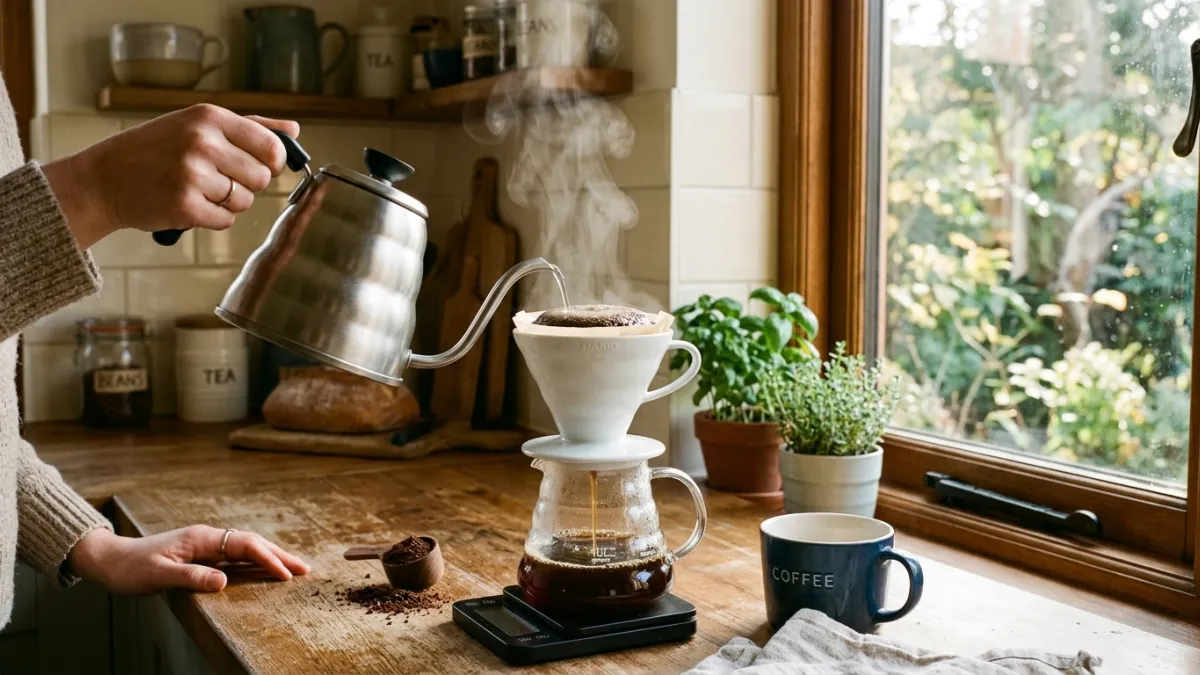
Pour-over coffee offers unmatched control over clarity and nuanced flavor notes. Follow this basic manual workflow to perfect your technique:
- Heat Water and Rinse Filter: Bring fresh filtered water to 200°F (93°C). Place a paper filter in your pour-over cone and rinse it thoroughly with hot water to wash away paper taste and preheat the brewer. Discard the rinse water.
- Dose and Grind Beans: Weigh 20 grams of whole coffee beans and grind them to a medium-fine setting. Add grounds to the filter and tap gently to level the bed.
- The Bloom Phase: Tare your scale to zero. Start a timer and pour approximately 60 grams of hot water in a slow spiral starting from the center outward. Allow the coffee bed to bloom for 30 to 45 seconds. This process releases trapped carbon dioxide gas (degassing), enabling uniform extraction.
- Main Pour Sequence: Continue pouring in steady, concentric circles, keeping the water level stable. Pour until your scale reads 320 grams total water weight (achieving a 1:16 ratio). Avoid pouring directly onto the paper filter walls.
- Drawdown and Serve: Give the brewer a light swirl during final drawdown to create a flat, uniform coffee bed. Once water passes through completely (around the 3:00 minute mark), remove the dripper, swirl your carafe, and enjoy.
Fellow Stagg EKG Pro Gooseneck Electric Kettle, Brew Timer, 0.9 Liter

Troubleshooting Common Brewing Problems
When a cup does not taste right, logical adjustments yield quick fixes without discarding beans needlessly.
If Your Coffee Tastes Sour or Thin
Sourness indicates under-extraction. Water passed through the coffee bed without pulling out balanced sugars. To fix this, adjust your grinder finer, increase water temperature by 2–4 degrees, or slightly extend contact time.
If Your Coffee Tastes Bitter or Astringent
Bitterness indicates over-extraction. Water dissolved harsh, wood-like compounds from the grounds. Remedy this by coarsening your grind setting, lowering water temperature slightly, or speeding up your pour cycle.
Frequently Asked Questions
【Silver】KINGrinder K6 Manual Coffee Grinder Straight Handle Stainless Burr

Should I store coffee beans in the freezer?
Whole coffee beans can be frozen long-term if kept in an airtight, opaque, vacuum-sealed container. Avoid opening the container while cold to prevent condensation from forming on the beans, which degrades delicate aromatic oils.
What is the difference between immersion and percolation brewing?
Immersion methods (like French Press or Clever Dripper) immerse grounds in water for the full duration, producing a heavy body and balanced cup. Percolation methods (like pour-over or drip) continually pass fresh water through a bed of grounds, resulting in higher clarity and brighter acidity.
How often should I clean my home brewing gear?
Rinse all equipment thoroughly after every brew. Wash removable components with warm soapy water daily, and perform a dedicated descaling cycle on electrical machines every 1 to 3 months using an organic citric-acid descaling liquid.