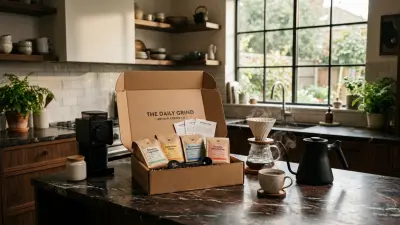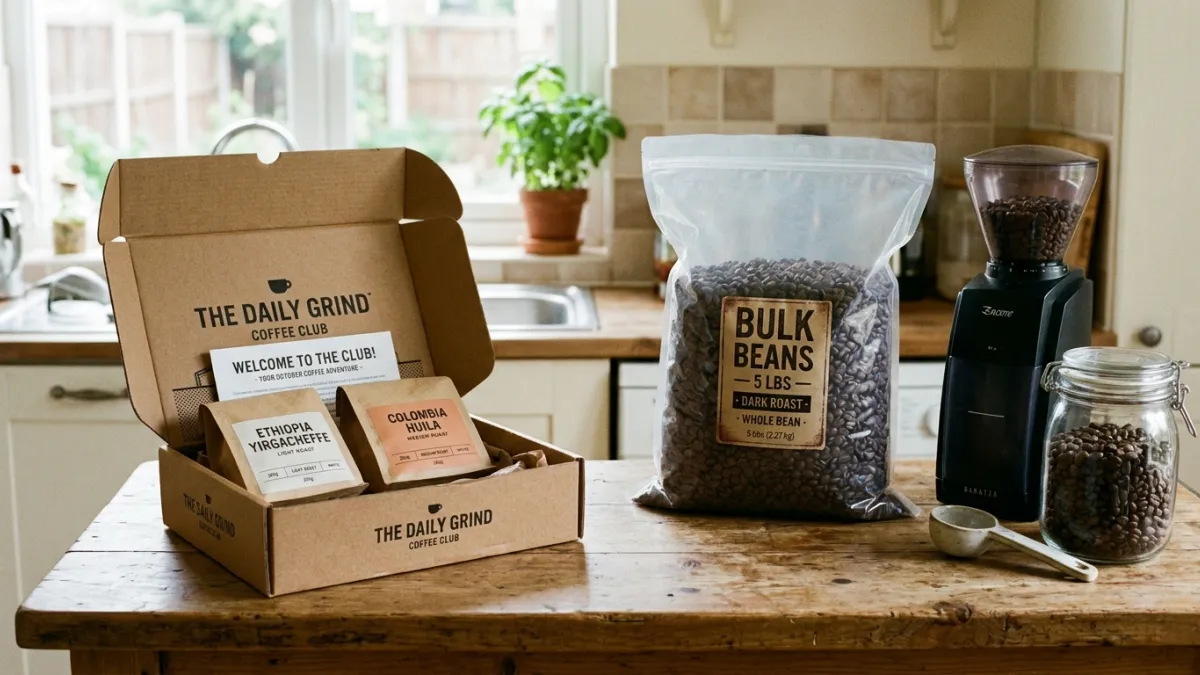
Deciding how to supply your daily home brewing habit usually comes down to a clear financial and sensory crossroads: setting up a recurring coffee subscription or stocking up on massive bulk bags. At first glance, buying coffee in bulk seems like the undisputed champion for your wallet. Wholesale pricing and volume discounts drop the upfront cost per ounce significantly. However, once you factor in bean degradation, extraction efficiency, and hidden shipping costs, calculating the true price of your daily cup becomes much more nuanced.
Quick answer: Buying in bulk delivers a lower sticker price per ounce (often $0.40–$0.60 per cup), but coffee subscriptions frequently save more money overall for single-brewers and couples by eliminating wasted, stale beans and offering 5% to 15% recurring delivery discounts on freshly roasted coffee.
The True Price Per Ounce: Breakdown of the Initial Math
To evaluate whether a specialty coffee subscription or buying in bulk saves more money, you must look beyond the initial checkout total. Standard retail bags from specialty roasters generally weigh 12 ounces (340 grams), whereas bulk offerings typically range from 2 pounds (907 grams) to 5 pounds (2.26 kilograms). On standard retail shelves or subscription portals like Trade and Blue Bottle, a high-grade 12-ounce bag costs between $15.00 and $24.00, yielding a unit price of roughly $1.25 to $2.00 per ounce. Subscribing to these roasters usually unlocks a 5% to 15% recurring discount along with free or reduced shipping.
Conversely, purchasing a 5-pound bulk bag of single-origin or blended whole-bean coffee generally reduces the price to around $45.00 to $70.00 total. That lowers your raw cost per ounce down to $0.56 to $0.87. If you consume every single gram of that bulk bag at peak flavor, bulk purchasing wins the mathematical sprint effortlessly. You receive significantly more raw ingredient per dollar spent, making it an appealing option for high-volume households.
However, coffee is an organic product, not a shelf-stable pantry staple. The moment raw price per ounce is converted into actual extracted beverage, invisible variables like staling, dialing-in waste, and storage equipment expenses start eating away at bulk savings. Calculating true value requires looking at what happens inside the bag over a four-to-six-week period.
The Hidden Cost of Stale Beans and Degassing
Freshly roasted specialty coffee undergoes rapid carbon dioxide degassing for the first 48 to 72 hours post-roast, reaching its flavor sweet spot between days 7 and 21. Specialty Coffee Association (SCA) standards emphasize that once whole beans hit the 30-day mark post-roast, delicate aromatics and organic acids break down due to oxidation. As coffee oxidizes, its cellular structure weakens, causing soluble solids to dissolve prematurely during brewing and yielding flat, bitter, or hollow cups.
When you open a 5-pound bulk bag, oxygen immediately floods the package. Opening that bag daily introduces moisture and ambient air, drastically accelerating degassing. By week three, the beans lose their volatile aroma compounds. By week five, you are often brewing dry, woody coffee that demands extra dose weight or tighter grind settings just to pull a passable cup.
Barista's tip: If your espresso shot pulls in under 18 seconds with severe channeling and pale cremaless flow despite using a fine grind setting, stale bulk beans are likely the culprit. As coffee ages and loses CO2, it loses internal resistance, forcing you to throw out multi-gram doses just to re-dial your burr grinder.
If you end up throwing out the last 20% of a 5-pound bulk bag because it tastes flat, your effective cost per usable ounce rises dramatically. Wasted coffee completely erases the initial volume discount, making a fresh, pay-as-you-go subscription noticeably cheaper per unit of quality coffee consumed.
Comparing Financial and Practical Variables
To help you decide which path aligns with your daily routine and equipment setup, the table below breaks down the key cost, freshness, and usability factors between subscriptions and bulk purchases.
| Factor | Coffee Subscription Model | Buying in Bulk (2 lb to 5 lb) |
|---|---|---|
| Average Bag Size | 12 oz (340 g) or 250 g | 2 lb to 5 lb (907 g to 2.26 kg) |
| Average Cost per Ounce | $1.15 – $1.65 (with sub discount) | $0.55 – $0.90 |
| Roast Freshness Window | Arrives within 3–7 days of roast date | Fresh on arrival, degrades after 2–3 weeks |
| Storage Requirements | Standard airtight canister or original bag | Vacuum sealer, mason jars, deep freezer setup |
| Wastage Risk | Very Low (consumed within peak freshness) | Medium to High (oxidation / staling waste) |
| Ideal Daily Household Volume | 1 to 3 cups per day (18 g – 54 g daily) | 4+ cups per day or multi-coffee drinker homes |
How to Calculate Your Personal Cost Per Cup
Determining which option saves you real money requires looking at your daily brew ratio and dosing metrics. A standard specialty drip or pour-over brew ratio sits between 1:15 and 1:17 (coffee to water weight). For espresso, standard double-dose recipes use 18 grams of ground coffee to yield 36 grams of liquid espresso in 25 to 30 seconds. A single 18-gram dose pulled once per day uses 126 grams of coffee per week, meaning a standard 12-ounce (340 g) subscription bag lasts exactly 19 days.
Let's compare the mathematics for a household drinking two 18-gram cups per day (36 grams total per day, or 1,080 grams monthly):
- Subscription Route: You order three 12-ounce bags per month at $17.00 per bag (after a 15% subscriber discount and free shipping). Total monthly expenditure: $51.00. Cost per 18 g cup: roughly $0.85. Waste factor: 0%.
- Bulk Purchase Route: You buy one 5-pound bag (2,268 grams) for $55.00 plus $8.00 shipping. Total cost: $63.00. If you drink 1,080 grams over 30 days and keep the remaining 1,188 grams fresh via proper vacuum sealing and freezing, your raw cost per 18 g cup is roughly $0.50.
If you have the tools to keep bulk beans fresh, bulk buying wins on paper. However, if you do not own a vacuum sealer or dedicated freezer space, the un-frozen second half of that 5-pound bag will stale by day 35. Throwing out stale beans or doubling your dose to compensate for weak flavor spikes your actual cost per drink, rapidly closing the gap with subscription prices.
Storage Infrastructure: The Hidden Bulk Expense
To make bulk buying financially viable without sacrificing flavor, you must invest in proper storage infrastructure. Leaving a 5-pound bag open on your kitchen counter leads to rapid oxidation. Sunlight, ambient humidity, and temperature fluctuations degrade delicate aromatic compounds in roasted coffee beans.
Proper bulk preservation requires dividing your large bag into smaller, single-week portions on the day of arrival. You must vacuum-seal these portions in oxygen-barrier bags and freeze them immediately at sub-zero temperatures. When retrieved, the sealed sub-bag must thaw completely to room temperature before opening to prevent ambient moisture from condensing on the cold beans.
Factoring in the cost of a quality vacuum sealer ($50 to $120), specialized food-grade vacuum bags ($15 per roll), and airtight storage canisters like Fellow Atmos or Airscape ($30 to $40 each) adds an upfront capital expense to bulk buying. A coffee subscription eliminates these costs entirely by delivering small, freshly roasted 12-ounce bags right as your previous bag runs out.
Tell us what your primary goal is: if your main priority is drinking rotating single-origin beans at absolute peak freshness without managing freezer space, set up a flexible 12-ounce coffee subscription. If you brew high daily volumes for a large family or office and own a reliable vacuum sealer, purchasing 2-pound to 5-pound bulk bags will deliver tangible long-term savings.
Frequently Asked Questions
Does freezing whole coffee beans actually preserve their roast profile?
Yes, freezing whole bean coffee in airtight, vacuum-sealed portions drastically slows degassing and chemical oxidation. You must freeze the beans in small doses and allow the sealed container to reach room temperature before opening to prevent moisture condensation on the bean surface.
How much discount do coffee subscriptions usually offer?
Most specialty coffee roasters and subscription services offer a 5% to 15% discount on recurring orders compared to standard one-off retail purchases, frequently pairing the plan with free or flat-rate shipping.
How long do whole coffee beans stay fresh after roasting?
Whole coffee beans stay at peak flavor between 7 and 28 days post-roast when stored in an airtight, dark container at room temperature. Pre-ground coffee loses its aroma compounds within minutes of grinding due to increased surface area exposure to oxygen.
Can I switch or pause subscription deliveries easily?
Modern specialty coffee subscription services allow you to adjust your delivery frequency, pause shipments, or change your roast choices online without cancellation fees or long-term contract lock-ins.
Sources
- National Coffee Association USA - Coffee Freshness and Storage Standards
- Specialty Coffee Association - Extraction and Freshness Standards
Looking for the Right Brewing Gear?
Check out our verified Top Coffee Brewing Essentials on Amazon.
As an Amazon Associate, we earn from qualifying purchases.