
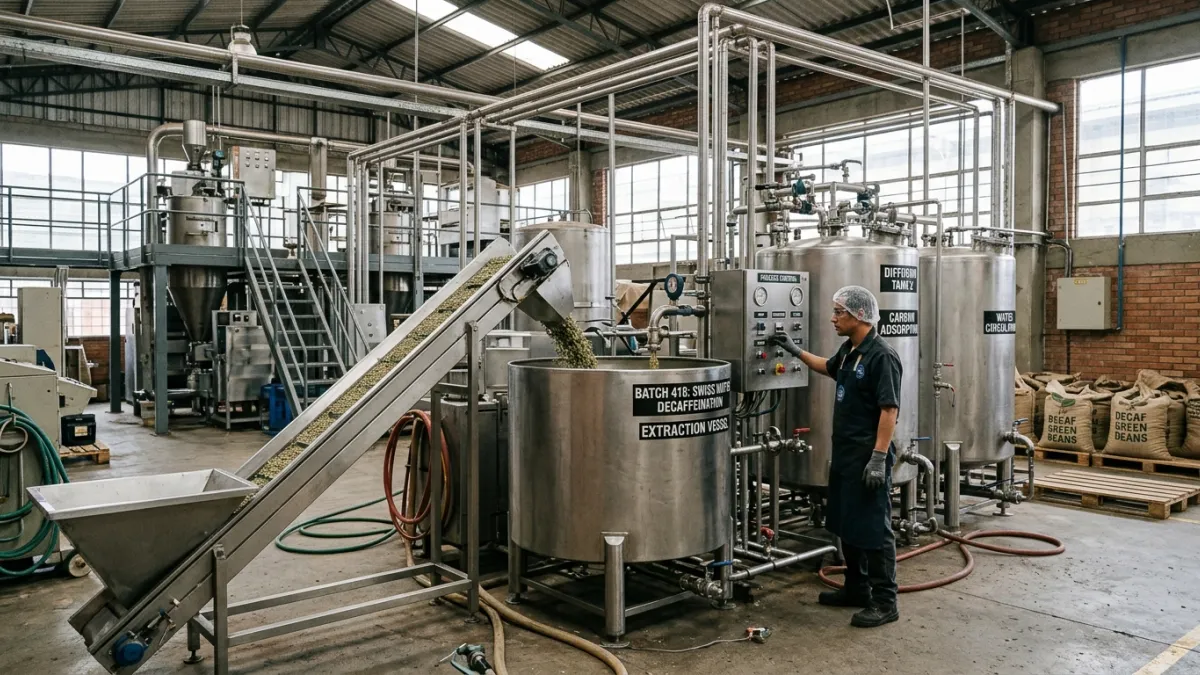
Decaffeinated coffee often carries an undeserved reputation as a watery, flavorless compromise. Decades ago, low-grade commodity beans stripped of their aromatic oils were standard for decaf production. Today, modern processing technology has fundamentally transformed how green coffee is decaffeinated. Specialty roasters now treat decaf with the exact same precision as their finest single-origin lots. However, understanding what goes into your morning mug requires looking beneath the surface of the roast to evaluate how the raw, unroasted green beans were processed. Decaffeination always occurs before roasting, when green coffee's cellular matrix is porous enough to release caffeine molecules without scorching essential lipids and sugars.
Quick answer: The Swiss Water Process strips caffeine using only water, temperature, time, and activated carbon filtration to achieve a 99.9% caffeine-free batch without synthetic solvents. Chemical processes rely on direct or indirect baths of solvents like methylene chloride or ethyl acetate to bind with caffeine, leaving behind trace residues strictly regulated under food safety standards.
The Chemistry of Decaffeination: How Green Coffee Is Processed
Every commercial decaffeination method begins with raw, unroasted green Arabica or Robusta beans. In their raw state, green coffee beans contain a complex matrix of over 1,000 chemical compounds, including chlorogenic acids, sucrose, proteins, lipids, and caffeine. Caffeine is a natural alkaloid that dissolves readily in water and organic solvents. The overarching challenge of decaffeination is selective extraction: removing caffeine while leaving all the desirable aromatic precursors and flavor compounds inside the bean structure.
To initiate the extraction, decaffeinators soak or steam the green coffee with water. This hydration step causes the bean structure to swell, widening its cellular pores. Once expanded, the caffeine molecules inside the bean become mobile. At this junction, processing facilities apply either water-based diffusion media or chemical solvents to draw the caffeine out across the cell walls. After extraction, the green beans are carefully dried back to a stable export moisture content of 10% to 12% before being shipped to specialty roasters worldwide.
Because green decaf beans have already undergone thermal and moisture manipulation, their cell walls become significantly more brittle than standard green coffee. As a home barista, this structural shift directly affects how the coffee roasts, grinds, and extracts in your kitchen. Decaf beans absorb heat much faster during roasting, resulting in a darker visual appearance at lower final internal temperatures. This structural alterability means decaf demands precise handling during grinding and extraction to avoid over-extraction and channel formation.
The Swiss Water Process: 100% Solvent-Free Decaffeination
Patented in Switzerland in the 1930s and commercially refined in British Columbia, Canada, the Swiss Water Process (SWP) is a non-solvent decaffeination method. It relies entirely on solubility equilibria, temperature control, and carbon filtration to remove caffeine. The mechanism uses a liquid known as Green Coffee Extract (GCE). GCE is pure water saturated with all the soluble flavor components, sugars, and chlorogenic acids found in green coffee—except for caffeine.
When fresh green coffee beans are immersed in heated GCE, a chemical concentration gradient is established. Because the GCE already holds maximum capacity of flavor solids, those compounds cannot dissolve out of the new beans. However, because the GCE lacks caffeine, the caffeine inside the beans diffuses naturally across the cell membrane into the liquid. The caffeine-laden GCE is then passed through proprietary activated carbon filters designed with a specific pore size that traps caffeine molecules while allowing flavor compounds to pass through. The refreshed GCE is continually recirculated until the batch reaches 99.9% caffeine removal, making SWP the choice method for certified organic specialty coffees.
Barista's tip: Decaf beans are significantly more porous and brittle than caffeinated beans due to pre-roast processing. When dialing in decaf espresso on a flat burr grinder, start your grind setting 2 to 3 micro-steps coarser than your standard profile. For an 18 g dose, target a 1:2 brew ratio (36 g out) in 26 to 28 seconds using water at 91–92 °C (196–198 °F). Off-boiling water will extract harsh, bitter tones from brittle decaf pucks.
Chemical Decaffeination: Methylene Chloride and Ethyl Acetate
Solvent-based decaffeination represents the vast majority of commercial decaf production globally. These methods are categorized into two primary direct and indirect solvent systems using either Methylene Chloride (MC) or Ethyl Acetate (EA). In a direct solvent process, steamed green beans are washed directly in a solvent bath, where the chemical bonds with the caffeine molecules. The liquid solvent is drained, and the beans are thoroughly steamed to evaporate residual chemical compounds before drying.
Methylene chloride is a volatile synthetic solvent with a low boiling point of 39.6 °C (103.3 °F). While health concerns persist among consumers, regulatory agencies such as the U.S. FDA enforce a strict maximum residue limit of 10 parts per million (ppm) in green coffee, though finished roasted coffee typically retains less than 1 ppm due to high roasting temperatures exceeding 200 °C (392 °F). Ethyl acetate, by contrast, is frequently labeled as the "Natural Process" or "Sugarcane Process" because it can be derived naturally from fermenting sugarcane molassses. EA decaffeination preserves sweet, fruit-forward notes exceptionally well, making sugarcane decaf popular among specialty coffee roasters seeking vibrant single-origin profiles.
Method Comparison: Swiss Water vs. Chemical Solvents
Evaluating decaffeination methods requires balancing flavor retention, environmental impact, caffeine purity, and safety regulations. While chemical processes are highly cost-effective for mass-market coffee products, non-solvent options like the Swiss Water Process provide certified organic compliance and complete solvent transparency.
The technical specifications, processing parameters, and extraction results across these primary methods highlight clear operational differences:
| Parameter / Metric | Swiss Water Process (SWP) | Methylene Chloride (MC) | Ethyl Acetate (Sugarcane EA) |
|---|---|---|---|
| Primary Active Agent | Pure Water & Green Coffee Extract | Synthetic Solvent (Dichloromethane) | Naturally Derived Organic Solvent |
| Caffeine Removal Efficiency | 99.9% Guaranteed | 96.0% – 97.0% Average | 97.0% – 99.0% Average |
| Organic Certification Eligibility | Fully Certified (USDA / EU Organic) | Ineligible | Ineligible (Synthetic EA blending common) |
| Target Residual Caffeine (18g Dose) | Less than 0.2 mg | approx. 3.0 mg – 5.0 mg | approx. 2.0 mg – 4.0 mg |
| Processing Flavor Impact | Preserves terroir & origin acidity | Mutes top notes; adds body | Enhances sweetness & fruity notes |
| Regulatory Residual Limit | Zero solvents used | 10 ppm (FDA threshold limit) | 10 ppm (FDA threshold limit) |
Brewing Precision: Dialing In Decaf Coffee at Home
Extracting high-grade decaf coffee at your home coffee bar requires adapting your recipe to the structural characteristics of decaffeinated beans. Because decaf coffee loses structural density during processing, water penetrates the cellular matrix far faster than in standard beans. If you brew decaf using your normal caffeinated recipe—especially with pour-over methods like the Hario V60 or Chemex—you risk heavy channel formation and astringent, over-extracted flavors.
To achieve clean clarity and balanced sweetness, refine your parameters according to these specialty standards:
- Dose & Ratio: Use an 18 g dose with a 1:15 to 1:16 brew ratio (18 g coffee to 270–288 g water) for pour-over, or a 1:17 ratio for French press.
- Grind Calibration: Grind slightly coarser to offset the high concentration of fines produced by brittle decaf beans. Aim for a medium setting (approx. 600–700 microns for pour-over).
- Water Temperature: Lower your kettle temperature to 90–92 °C (194–198 °F). Standard boiling water (96 °C / 205 °F) strips aggressive bitter compounds from decaf.
- Agitation & Bloom: Keep pouring agitation minimal. Extend the initial bloom phase to 45 seconds using 50 g of water to allow the porous ground coffee to settle evenly.
For home espresso setups equipped with high-precision burr grinders (such as Baratza or Fellow models), monitor your extraction flow rate carefully. Decaf pucks compress easily under 9 bars of pressure. Rest your decaf roasted coffee for 10 to 14 days post-roast to allow carbon dioxide gas levels to stabilize completely before dialing in.
If you prioritize complete organic purity, total chemical avoidance, and clear origin characteristics, select beans marked with the official Swiss Water Process seal. If you prefer high-sweetness profiles with rich caramel body, explore specialty Colombian Sugarcane Ethyl Acetate decafs. Whichever path you choose, purchase freshly roasted whole beans from specialty micro-roasters displaying roast dates within 2 to 4 weeks of use.
Frequently Asked Questions
Is decaf coffee completely free of caffeine?
No, decaffeinated coffee is not 100% caffeine-free. Federal standards require decaf to have at least 97% of its original caffeine removed, while the Swiss Water Process removes 99.9%. An 8-ounce cup of Swiss Water decaf contains roughly 0.1 to 2 mg of caffeine, compared to 95–180 mg in regular coffee.
Does chemical decaffeination leave harmful residues in the cup?
Chemical decaffeination processes are strictly monitored by global food safety authorities. Solvents like methylene chloride evaporate rapidly at low temperatures (around 40 °C). Because coffee is roasted at temperatures over 200 °C and brewed around 92 °C, residual chemical traces in finished beverages fall far below safe international threshold limits.
Why does decaf coffee look darker than regular roasted coffee?
Green coffee beans undergo pre-soaking and thermal drying during decaffeination, which changes their internal carbohydrate structure and moisture distribution. When roasted, decaf beans undergo accelerated Maillard reactions, making them look visually darker than regular beans at the exact same internal roast temperature.
Sources
- U.S. Food and Drug Administration (FDA) - Code of Federal Regulations Title 21
- Specialty Coffee Association (SCA) - Standards & Education Resource Center
- Swiss Water Decaffeinated Coffee Company - Technical Process Overview
Looking for the Right Brewing Gear?
Check out our verified Top Coffee Brewing Essentials on Amazon.
As an Amazon Associate, we earn from qualifying purchases.
