Disclosure: As an Amazon Associate, we earn from qualifying purchases.
brewing authentic Turkish coffee is a sensory ritual that dates back to the 16th century, demanding extreme precision in grind, temperature, and hardware. While the ultra-fine coffee powder and water quality lay the foundation, the vessel you choose dictates heat distribution, foam formation, and final flavor extraction. Known traditionally as a cezve in Turkey and often called an ibrik across international coffee circles, this tapered pot is far more than a decorative pitcher. Selecting the right vessel ensures you achieve the signature velvety micro-foam (köpük) without scorching the delicate grounds.Quick answer: For the ultimate balance of thermal conductivity and authentic foam production, a heavy-gauge (1.5mm to 2mm) hand-hammered copper ibrik lined with food-safe tin is the top choice for home baristas. Stainless steel ibriks offer exceptional durability and low maintenance for everyday convenience, but require extra care to avoid heat spikes that ruin the delicate brew layer.
Understanding the Anatomy and Thermal Dynamics of the Ibrik
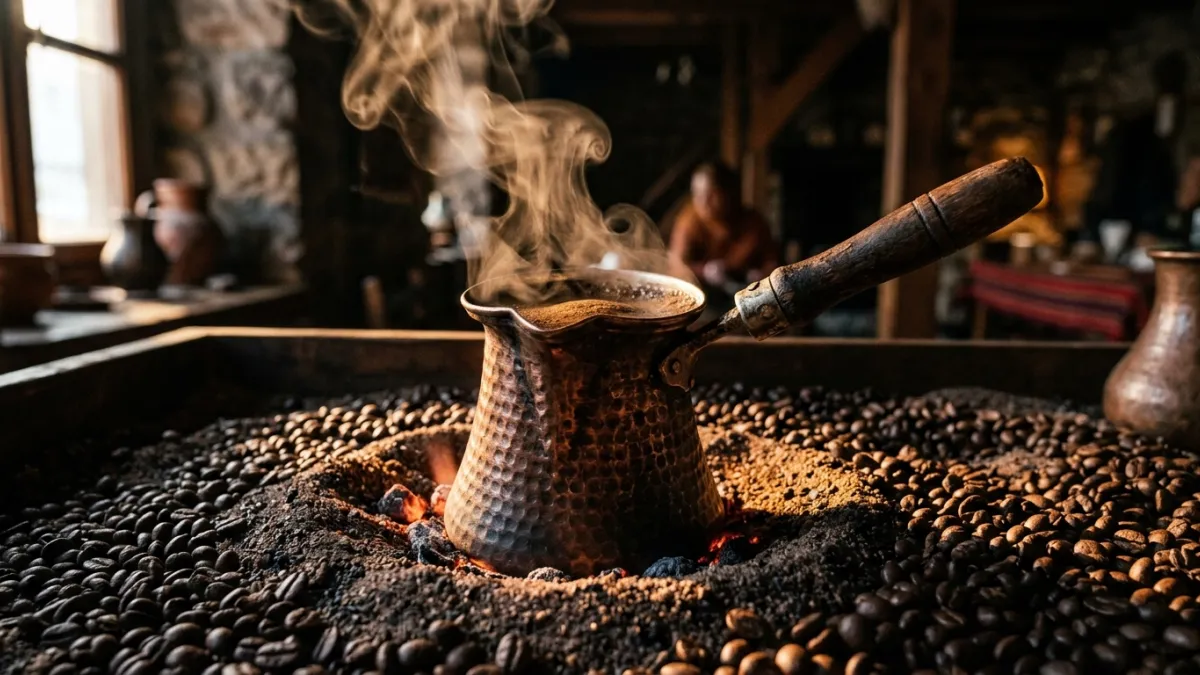
The traditional ibrik possesses a distinct geometry engineered specifically for immersive, unfiltered brewing. Its wide base captures heat rapidly from a gas flame, electric coil, or hot sand bed, while the narrow neck concentrates rising gases. As water heats up, coffee oils and fine solids form a thick foam seal at the constricted neck. This seal traps aromatic volatile compounds, effectively pressure-cooking the brew underneath without allowing it to boil violently.
Engineering a balanced cup requires a precise brewing standard. Turkish coffee utilizes an ultra-fine grind size, typically around 75 to 100 microns—significantly finer than table salt or standard espresso grinds. The standard golden ratio for Turkish coffee sits at 1:10 (coffee-to-water ratio), meaning approximately 7 grams to 8 grams of pulverized coffee per 70 to 80 milliliters of room-temperature water. Maintaining a total brew time between 2 to 2.5 minutes prevents over-extraction, keeping the Total Dissolved Solids (TDS) rich and mouth-filling without astringency.
Pouring mechanics rely heavily on the design of the pouring spout. A sharp, deeply contoured spout cuts off the stream cleanly, preventing fluid turbulence from pulling down the thick layer of foam you painstakingly built. If the neck is too wide or the spout is rounded, foam redistributes back into the main body, leaving you with a flat, thin cup. The handle angle also matters: an upward-slanted long handle keeps your hand away from direct stove heat while giving you full tilt control over the delicate pour.
Material Comparison: Copper, Stainless Steel, and Brass
The material composition of your cezve dictates how heat transfers through the vessel wall into the water column. Thermal conductivity varies drastically across metals, which directly influences how quickly the micro-foam builds up before the liquid boils over.
Barista's tip: Never preheat an empty tin-lined copper ibrik or wash it with abrasive pads. Tin has a low melting point of roughly 232 °C (450 °F), and stripping the lining exposes raw copper, which reacts with organic acids in coffee to create harsh off-flavors and potential toxicity.
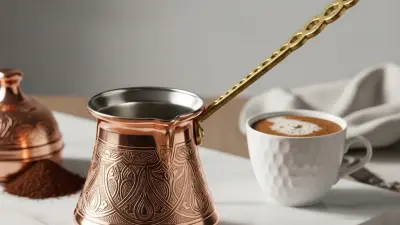
Copper remains the undisputed gold standard for competition-grade Turkish coffee brewing. Heavy-gauge copper (1.5mm thickness or higher) spreads heat laterally across the entire vessel rather than creating direct hot spots at the base. This uniform heating raises water temperature evenly from 20 °C to the target range of 90–94 °C (194–201 °F). Because copper is chemically reactive with natural coffee acids, high-end manufacturers coat the interior with a non-reactive layer of pure tin or silver.
Stainless steel ibriks cater to modern kitchens, particularly those utilizing induction stovetops (when constructed with a magnetic base). Stainless steel is extremely durable, dishwasher-safe, and completely non-reactive. However, steel conducts heat poorly compared to copper—roughly 15 W/m·K compared to copper's 385 W/m·K. This means heat stays concentrated at the bottom, increasing the risk of burning the settled coffee grounds before the top foam has a chance to rise properly.
| Metal Type | Thermal Conductivity | Maintenance Level | Best Suitable For |
|---|---|---|---|
| Hand-Hammered Copper | Ultra High (~385 W/m·K) | High (Hand wash, re-tinning over time) | Purists, traditionalists, & competition brewing |
| Silver-Lined Copper | Exceptional (~429 W/m·K) | Medium-High (Resists wear better than tin) | Specialty cafes & professional baristas |
| Stainless Steel | Low (~15 W/m·K) | Very Low (Dishwasher safe, rust-proof) | Daily fast use & induction stovetops |
| Cast Brass | Moderate (~110 W/m·K) | Medium (Polishing required) | Decorative sets & occasional brewing |
The Authentic Choice: Hand-Hammered Thick Copper Ibrik

Sizing Your Ibrik for Optimal Foam Quality
Unlike standard drip carafes or French presses, you cannot brew half-batches in a large ibrik. A cezve must be filled precisely to its narrow shoulder to operate correctly. If you place 100 ml of water in a 400 ml capacity ibrik, the foam layer will spread out thinly across the wide body, cooling down prematurely and failing to rise up the neck.
A single-serve ibrik typically holds 100 to 150 ml of total capacity, making it perfect for preparing a single 60–80 ml demitasse cup (allowing appropriate headspace for rising foam). Dual-serve units range from 200 to 250 ml, which can accommodate two standard demitasse cups simultaneously. If you frequently host guests, owning two distinct sizes—a 1-cup and a 3-cup capacity pot—is far more effective than attempting to brew single portions in a oversized pot.
When selecting your pot size, keep the foam expansion ratio in mind. As the water approaches 90 °C, dissolved gases release rapidly, expanding the liquid volume by 20% to 30% in seconds. A properly proportioned ibrik offers just enough headroom above the liquid line for this crema-like foam to rise gently without overflowing onto your cooktop.
Sourcing, Maintenance, and Craftsmanship
Authentic ibriks crafted in regions like Istanbul, Gaziantep, or Armenia often feature solid hand-hammered designs. Hammering compacts the copper lattice, improving structural rigidity and heat distribution efficiency. Look for brands and artisans such as Soy Türkiye, Wooden Spoon Crafts, or Nusret Ceviz, who use heavy sheet copper rather than thin stamped metal shells that warp under direct heat.
Maintaining a solid copper ibrik requires simple, mindful habits. Clean the tin-lined interior gently with hot water and a soft micro-fiber sponge immediately after brewing; never use chemical descalers or scrub brushes. Over years of consistent use, the internal tin coating will naturally darken; this oxidation is harmless. Once silver-colored tin wears down enough to reveal raw red copper underneath, send the pot to a specialist for traditional re-tinning.
Handle construction is another key area of quality craftsmanship. Wooden handles attached via heavy rivets offer superior thermal isolation, staying comfortable to touch throughout brewing. Brass handles are aesthetically striking and historically accurate, but they absorb ambient stove heat quickly during longer brewing sessions, requiring a towel or silicone grip for handling.
How to Select the Right Setup
To choose the ideal vessel for your kitchen, evaluate your cooktop surface first: induction stoves require a magnetic stainless steel base or an induction adapter disc, whereas gas or electric coil stoves excel with traditional copper. If you prioritize historical authenticity and peak micro-foam volume, invest in a 1.5mm to 2mm hand-hammered copper ibrik sized specifically to your daily demitasse consumption. If low maintenance and dishwasher ease are non-negotiable, select a heavy-bottomed stainless steel model with an ergonomic, heat-isolated handle.
Modern & Low Maintenance: Premium Stainless Steel Cezve

Frequently Asked Questions
Can I use an ibrik on an induction stovetop?
Standard copper and brass ibriks do not work directly on induction cooktops because copper is non-magnetic. To use traditional copper on induction, you must place an induction converter disc on the element or choose a specialized stainless steel ibrik with a magnetic base plate.
What is the difference between an ibrik and a cezve?
The terms refer to the same brewing tool. "Cezve" (pronounced jez-veh) is the Turkish word derived from Arabic, whereas "Ibrik" is an Ottoman term widely used across Southeastern Europe, Greece, and North America to describe the long-handled pot.
Why did my Turkish coffee fail to produce foam?
Lack of foam usually stems from four main factors: using an oversized ibrik filled below its neck line, grinding coffee too coarsely, stirring the coffee late in the brew cycle, or applying excessive heat that boils the liquid rapidly rather than allowing a gradual foam build-up.
How fine should Turkish coffee be ground?
Turkish coffee requires an ultra-fine, powder-like grind with a particle size between 75 and 100 microns. It should feel like flour or powdered sugar between your fingertips, which requires a specialized burr grinder or traditional manual brass mill.
Sources
- Specialty Coffee Association (SCA) - Standards & Extraction Protocols
- Wikipedia - Turkish Coffee & Cezve History
- Soy Türkiye Craftsmanship Specifications & Re-tinning Directives