Every morning, millions of home baristas grind freshly roasted beans, carefully pour hot water, and savor that first restorative sip. Yet, behind this beloved daily ritual lies a subtle trail of inefficiency—stale whole beans discarded from forgotten bags, half-empty carafes tipped down the kitchen sink, and mountains of nutrient-dense spent grounds tossed into municipal landfills. Brewing exceptional coffee at home does not require sacrificing environmental responsibility; in fact, mastering precise extraction techniques directly minimizes waste while elevating the clarity and flavor profile of every single cup.
Quick answer: Sustainable home coffee brewing combines precision dosing (weighing beans to a 1:15 or 1:17 ratio), airtight dark storage, reusable filtration gear, and upcycling spent grounds into garden compost or household scrubbers. By controlling extraction parameters, you eliminate batch dumping, extend bean freshness, and divert valuable biomass from landfills.
1. Precision Extraction: Brewing Exact Volumes Without Waste
The single most effective way to cut down on morning coffee waste is to stop guessing quantities. When home brewers rely on volumetric scoops or uncalibrated water marks on glass carafes, extraction consistency suffers dramatically. Over-extracted coffee tastes unpleasantly bitter and astringent, while under-extracted coffee tastes unpleasantly sour and thin. Both outcomes frequently end up down the drain, wasting precious specialty beans and energy.
Adopting the specialty coffee association (SCA) golden cup standards transforms your routine into a repeatable, zero-waste science. Using a digital scale with 0.1-gram accuracy allows you to weigh both your dry coffee dose and your total water output. A standard single-cup pour-over typically utilizes 18 grams of ground coffee to 300 grams of water, reflecting a balanced 1:16.6 ratio. For immersion brewing like a French Press, a 1:15 ratio (20 grams of coffee to 300 grams of water) yields a richer body without leaving unneeded liquid in the press.
Barista's tip: Avoid the habit of filling a drip brewer's reservoir to its maximum capacity "just in case." Dial in your personal mug volume first—fill your preferred coffee mug with water, weigh that exact mass on a digital scale, and calculate your dry coffee dose based on a 1:16 brew ratio. You will brew precisely what you drink, down to the last milliliter.
Temperature control and grind size alignment further ensure that every brew reaches optimal total dissolved solids (TDS) between 1.15% and 1.45%, corresponding to an extraction yield of 18% to 22%. water temperature should consistently measure between 90°C and 96°C (195°F to 205°F). If your water is too cool, extraction drops, forcing you to use more coffee to achieve perceived strength—an unnecessary form of waste that quickly depletes your coffee supply.
2. Advanced Bean Preservation and Freshness Management
Whole coffee beans are organic products vulnerable to four primary environmental enemies: oxygen, moisture, heat, and direct light. When roasted coffee is exposed to oxygen, delicate volatile aromatic compounds degrade rapidly within days. Stale beans produce flat, woody cups that lack sweetness and acidity, prompting consumers to discard partially used bags prematurely.
To maximize bean longevity, purchase whole beans stamped with a clear roast date rather than a generic expiration date. Coffee beans reach peak flavor expression between 7 to 21 days post-roast, as carbon dioxide degassing stabilizes. Buying 250-gram or 12-ounce bags tailored to your bi-weekly consumption prevents beans from sitting idle in open pantries. If you purchase in bulk, divide whole beans into single-dose air-tight glass vials or vacuum canisters like the Fellow Atmos or Airscape container, keeping daily light and air exposure to an absolute minimum.
Grinding on demand using a quality conical or flat burr grinder (such as a Baratza Encore or Fellow Ode) dramatically outperforms blade grinders, which create inconsistent particle distributions containing excessive fines and boulders. Uniform particle sizes ensure predictable flow rates—whether a 25-to-30 second espresso shot or a 3-minute V60 pour-over—reducing the likelihood of channelled, ruined shots that get thrown away.
3. Waste-Free Gear and Eco-Friendly Equipment
Selecting durable, sustainable coffee hardware drastically reduces the consumer lifecycle impact of your home setup. Single-use plastic capsules and bleached paper filters accumulate significant waste over time. Transitioning to permanent or compostable alternatives eliminates recurring trash while providing complete control over tactile brewing variables.
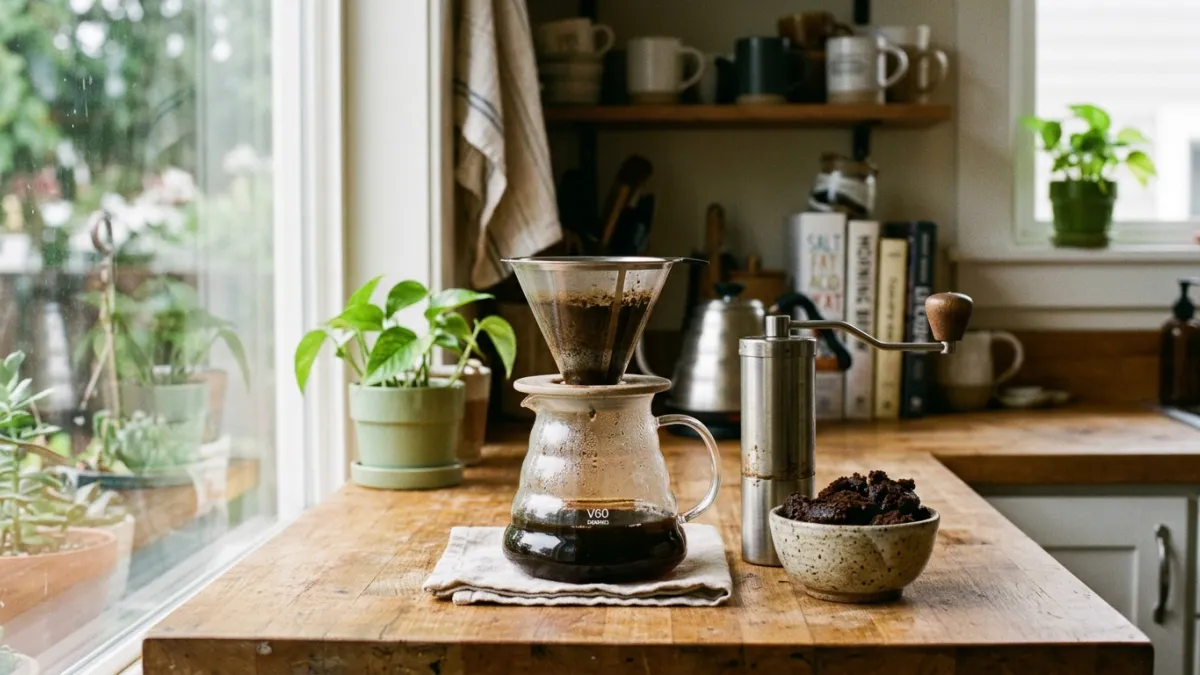
Reusable stainless steel mesh filters (like the Able Kone) or organic unbleached cotton filter cones allow subtle coffee oils and micro-colloids to pass through into your cup, increasing body while removing the need for daily paper disposal. If paper filters remain your preference for light-roast clarity, opt for uncomposted, unbleached oxygen-bleached filters certified for home composting systems.
| Brewing Method | Filter Type | Optimal Ratio | Brew Time | Waste Impact Level |
|---|---|---|---|---|
| French Press | Built-in Stainless Steel Mesh | 1:15 (e.g., 20g to 300g) | 4:00 minutes | Very Low (Zero paper waste) |
| Hario V60 | Unbleached Paper / Cloth Filter | 1:16.6 (e.g., 18g to 300g) | 2:30–3:15 minutes | Low (Compostable filter) |
| AeroPress | Reusable Metal Disk / Fine Paper | 1:14 (e.g., 15g to 210g) | 1:30–2:00 minutes | Very Low (Compact puck, low water waste) |
| Home Espresso | Portafilter Stainless Basket | 1:2 (e.g., 18g dose to 36g yield) | 25–30 seconds | Very Low (Dense dry pucks ideal for reuse) |
Manual brewing methods like the French Press, glass Chemex, or stainless steel Moka Pot feature minimal mechanical failure points compared to complex pod machines. Fewer moving parts mean a longer appliance lifespan, keeping electronic waste out of industrial disposal facilities while giving you total authority over water composition and extraction metrics.
4. Creative Upcycling: Repurposing Leftover Brew and Spent Grounds
Even with calibrated ratios, small amounts of brewed liquid or abundant spent coffee grounds (SCGs) remain. Globally, spent coffee grounds account for millions of tons of organic municipal waste annually, which releases methane—a potent greenhouse gas—when decomposing anaerobically in landfills. Diverting spent grounds into circular home applications keeps valuable organic matter in active use.
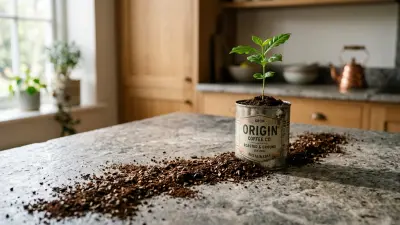
Spent coffee grounds serve as an exceptional addition to active compost piles. Rich in nitrogen (holding an average carbon-to-nitrogen ratio around 20:1), SCGs accelerate microbial decomposition when balanced with carbon-rich brown materials like dried leaves or cardboard. Alternatively, mixing dried grounds directly into soil benefits acid-loving plants such as hydrangeas, blueberries, and azaleas, while improving soil structure and moisture retention.
- Coffee Ice Cubes: Pour unconsumed liquid brew into silicon ice trays. Use these frozen cubes in cold brews or iced lattes to prevent water dilution.
- Culinary Flavor Enhancer: Add excess concentrated filter coffee into dark chocolate cake batters, chili con carne, or red meat marinades to introduce deep, savory complexity.
- Exfoliating Body Scrub: Combine dried spent grounds with cold-pressed coconut oil and a pinch of coarse sea salt for an all-natural skincare scrub.
- Natural Odor Neutralizer: Place a small bowl of thoroughly dried grounds inside the refrigerator or pantry to absorb strong food odors without synthetic fragrances.
- Abrasive Household Cleaner: Use damp spent grounds on a sponge to scrub stubborn burnt food residue off cast iron cookware or stainless steel pots without harsh chemical agents.
Before using spent grounds for household crafts or dry storage, spread them thinly on a baking tray and dry them completely in an oven at a low temperature or under direct sunlight. Removing residual moisture prevents mold growth, extending the shelf life of your upcycled creations.
For immediate action, evaluate your current kitchen workflow today: replace unmeasured scoops with a digital scale set to a 1:16 ratio, store your beans in a dark vacuum container, and dedicate a small container on your counter for dry spent grounds destined for garden compost.
Frequently Asked Questions
Are coffee grounds safe to pour down the kitchen sink drain?
No, coffee grounds should never be washed down the drain. Even with heavy water flow, dense grounds do not dissolve; instead, they mix with residual grease and fats in household plumbing, causing severe blockages deep within municipal drain pipes.
Can I freeze whole coffee beans to keep them fresh longer?
Yes, but only if done correctly. Freeze whole beans in unopened original bags with one-way valves or in vacuum-sealed single-dose portions. Avoid taking a large bag in and out of the freezer daily, as condensation will form on the frozen beans, destroying essential aromatic oils and inducing premature staleness.
Do cloth coffee filters harbor bacteria over time?
Cloth filters remain perfectly hygienic if thoroughly rinsed with boiling water immediately after each extraction. Store washed cloth filters submerged in a clean jar of water inside your refrigerator, changing the water every few days to keep the fabric fresh and odor-free.
How much coffee waste can a digital scale actually prevent?
Weighing coffee typically saves 2 to 5 grams of wasted beans per brew compared to volumetric scooping. Over a full year of daily home brewing, this precision saves up to 1.8 kilograms (4 pounds) of specialty whole bean coffee from being improperly extracted or discarded.