Hey there, fellow coffee enthusiast! If you're serious about brewing delicious coffee at home, you already know that a great grinder is the cornerstone of any setup. It's even more important than your fancy espresso machine or pour-over brewer! But once you start looking, you'll quickly encounter a fundamental question: Should you go for a conical burr or a flat burr grinder?
It's a debate as old as specialty coffee itself, and for good reason. Both types have their champions and their unique characteristics that can significantly impact the taste in your cup. As your trusted barista friend, I'm here to demystify the differences, explain the pros and cons, and help you decide which one is the perfect fit for your brewing style and preferences.
Understanding the Grinding Mechanism
Before we dive into the flavor profiles, let's understand how these two types of grinders actually work.
Conical Burr Grinders: The Workhorses
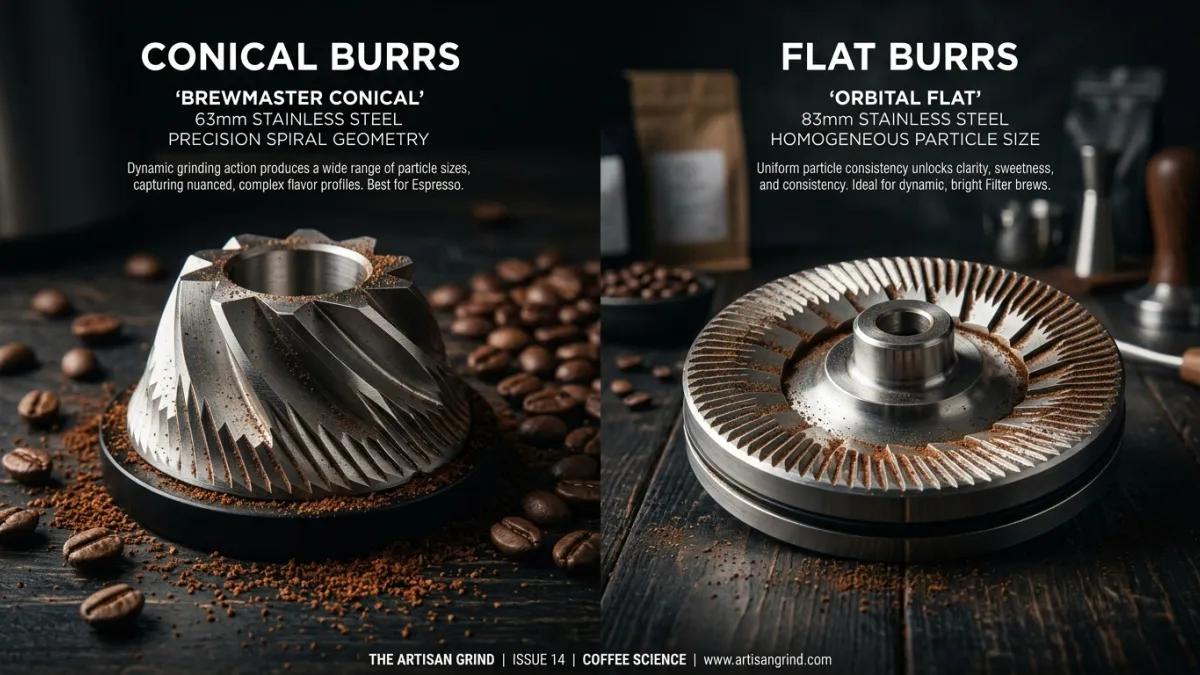
Conical burr grinders feature two cone-shaped burrs: an inner cone (which rotates) and an outer ring (which is stationary). Coffee beans are fed between these two burrs, crushed, and then fall through a progressively narrower gap as they move down, resulting in the desired grind size. Think of it like a funnel where the coffee gets smaller as it exits.
- How they work: Gravity feeds beans downwards through two interlocking cone-shaped burrs.
- Particle Distribution: Tend to produce a slightly more "bimodal" distribution, meaning you get a mix of very fine particles (fines) and larger particles (boulders) along with your desired grind size.
Flat Burr Grinders: The Precision Tools
Flat burr grinders, on the other hand, use two parallel, ring-shaped burrs. One burr is stationary, and the other rotates, with the coffee beans being fed into the center and then "flung" outwards between the two flat surfaces. The grind size is determined by the distance between these two flat burrs.
- How they work: Beans are fed between two flat, parallel burrs – one rotating, one stationary – and ground as they move outwards.
- Particle Distribution: Generally produce a more "unimodal" grind, meaning the particles are more uniform in size, with fewer extreme fines or boulders.
The Impact on Your Cup: Taste and Texture
This is where the rubber meets the road! The difference in particle distribution translates directly into how your coffee tastes and feels.
Conical Burr Grinders: Body and Balance
Due to their slightly more bimodal grind distribution (a mix of fines and larger particles), conical burr grinders are often associated with:
- Fuller Body: The presence of fines can contribute to a richer, thicker mouthfeel, especially in espresso.
- Balanced Flavor: They can produce a well-rounded cup, often enhancing perceived sweetness and muting some of the brighter, more acidic notes.
- Versatility: Excellent for a wide range of brewing methods, from espresso to French press.
Example: The Baratza Encore is a fantastic entry-level conical grinder, while the Baratza Sette 270 is a powerhouse for espresso lovers, both using conical burrs.
Flat Burr Grinders: Clarity and Complexity
The unimodal grind of flat burr grinders, with their more consistent particle size, is often favored for:
- Exceptional Clarity: You'll taste distinct flavor notes more clearly, allowing the nuanced characteristics of the coffee bean to shine through.
- Brighter Acidity: Can highlight the vibrant acidity and complex aromatics of specialty coffees, especially in pour-overs.
- Clean Finish: Often results in a very clean cup with minimal sediment.
Example: The Eureka Mignon Specialita is a popular flat burr grinder known for its espresso performance, and the Fellow Ode Brew Grinder Gen 2 (with its upgraded burrs) is a champion for filter brewing.
Beyond Taste: Practical Considerations for Home Baristas
Choosing a grinder isn't just about taste; it's also about usability, budget, and lifestyle.
- Noise: Generally, conical burr grinders tend to be quieter in operation. Flat burrs, especially at higher speeds, can be noticeably louder.
- Heat Generation: Flat burrs can generate more heat due to the friction between the parallel surfaces, which can potentially impact coffee flavor if grinding large quantities. Conical burrs, due to their design, typically generate less heat.
- Retention: This refers to the amount of ground coffee left inside the grinder after use. Many conical grinders, like the Niche Zero, are designed for very low retention. Some flat burr grinders can have higher retention, meaning you might lose a small amount of coffee or have stale grounds mix with fresh ones.
- Cleaning and Maintenance: Both types require regular cleaning, but the design of conical burrs can sometimes be slightly easier to access for brushing.
- Cost: While there are excellent grinders in both categories across various price points, high-end flat burr grinders often command a premium due to the precision engineering required for their burrs.
- Speed: Conical burrs often grind faster than flat burrs, especially at coarser settings.
Which One is Right for You?
There's no single "best" burr type; it truly depends on your priorities and what you seek in your daily brew.
- For the Espresso Enthusiast (Body & Sweetness): Many home baristas love conical burrs for espresso, appreciating the body and perceived sweetness they deliver. Grinders like the Baratza Sette or Niche Zero are excellent choices here.
- For the Espresso Enthusiast (Clarity & Precision): If you chase clarity, bright acidity, and want to really dissect the nuanced flavors in your espresso, a quality flat burr grinder like a Eureka Mignon Specialita is often preferred.
- For the Pour-Over/Filter Fan (Clarity is Key): Flat burr grinders often excel for pour-over, Aeropress, or drip coffee, where clarity and distinct flavor separation are highly valued. The Fellow Ode Gen 2 or a Baratza Virtuoso+ (which has flat burrs, though some other Baratza models are conical) are great options.
- For the All-Rounder on a Budget: conical burr grinders like the Baratza Encore are fantastic workhorses that provide a consistent grind for almost any brew method without breaking the bank.
- For Quiet Operation and Low Retention: Conical burrs generally have an edge here.
The Final Grind
Ultimately, both conical and flat burr grinders are capable of producing excellent results, far superior to blade grinders (which you should absolutely avoid!). Your choice comes down to personal preference for taste, your primary brewing methods, budget, and practical considerations like noise and retention.
Think about what you value most in your coffee. Do you crave a rich, full-bodied espresso, or a vibrant, clear pour-over that highlights every single note? Whichever you choose, investing in a quality burr grinder will be the single most impactful upgrade you can make to your home brewing experience. Happy grinding!