Welcome, fellow coffee enthusiasts, to Coffee Brew Hub! If you've embraced the art of pour over, you know it's a method that rewards precision. And at the heart of that precision lies one crucial question: What is the ideal pour over coffee ratio, and how much coffee per cup should you use? Getting this right is the cornerstone of unlocking your coffee's full potential, transforming your kitchen into a personal café.
The Foundation: Understanding the Golden RatioWhen we talk about coffee ratios, we're referring to the proportion of coffee grounds to water by weight. For pour over, the industry-standard recommendation, often called the "Golden Ratio," is typically between 1:15 and 1:18. This means for every 1 gram of coffee, you'll use between 15 and 18 grams of water.
While the Golden Ratio serves as an excellent starting point, remember that coffee brewing is also a journey of personal preference. Your ideal ratio might fall slightly outside this range, and that's perfectly fine! The key is to understand how to apply it and adjust it to your palate.
Frequently Asked Questions About Pour Over Ratios
What is the ideal coffee to water ratio for pour over?
As mentioned, the sweet spot for pour over is generally between 1:15 and 1:18 (coffee to water). A good place to start experimenting is 1:16 or 1:17. This range aims for optimal extraction, balancing strength and flavor without over- or under-extracting your grounds. For example, a 1:16 ratio means 1 gram of coffee for every 16 grams of water.
How do I calculate my coffee and water amount for a single cup?
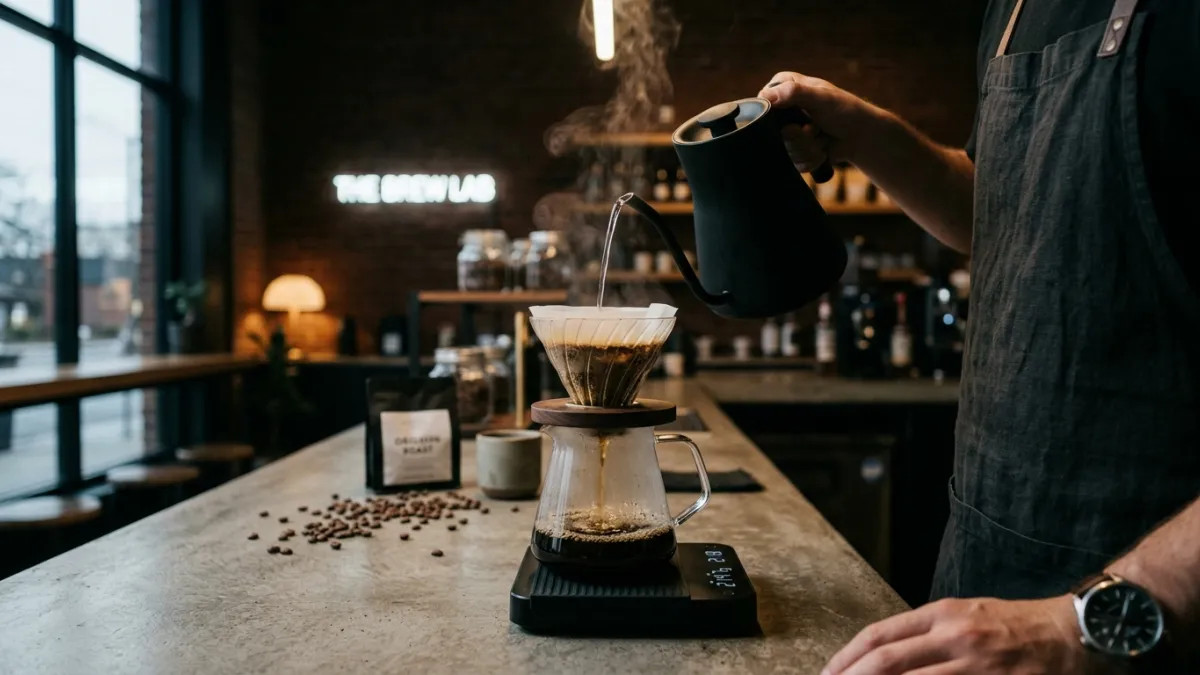
This is where your digital scale becomes your best friend. Most standard coffee mugs hold roughly 250-300ml of liquid. Since water density is approximately 1 gram per 1 milliliter, we can easily convert volume to weight.
- Determine your desired water volume: Let's say you want to brew 250ml of coffee, which equals 250 grams of water.
- Choose your ratio: We'll start with 1:16.
- Calculate coffee weight: Divide your water weight by your ratio. For 250g of water, you'd use 250g / 16 = 15.6 grams of coffee.
So, for a 250ml cup at a 1:16 ratio, you'd use about 15.6 grams of coffee.
Does the type of coffee or roast level affect the ratio?
Absolutely! Different coffees and roasts have varying densities and solubility. Lighter roasts are typically denser and require a bit more effort to extract, so you might lean towards a slightly narrower ratio (e.g., 1:15 or 1:16) to ensure full flavor development. Conversely, darker roasts are more porous and extract faster, often performing better with a wider ratio (e.g., 1:17 or 1:18) to avoid bitterness. Experimentation is key here!
What if my coffee tastes too strong or too weak? How do I adjust the ratio?
Your taste buds are the ultimate judge!
- If your coffee tastes too strong, bitter, or astringent: This often indicates over-extraction or too high a concentration. Try a wider ratio (e.g., move from 1:16 to 1:17 or 1:18), meaning you're using less coffee for the same amount of water.
- If your coffee tastes too weak, sour, or watery: This suggests under-extraction or too low a concentration. Opt for a narrower ratio (e.g., move from 1:17 to 1:16 or 1:15), meaning you're using more coffee for the same amount of water.
Remember to change only one variable at a time (ratio, grind size, temperature) so you can accurately pinpoint the impact of each adjustment.
Is it okay to use volumetric measurements (spoons) instead of a scale?
While convenient, volumetric measurements like tablespoons or scoops are inherently inaccurate for coffee brewing. The density of coffee grounds varies significantly based on roast level, grind size, and bean type. A scoop of light roast will weigh differently than a scoop of dark roast. For consistent, repeatable, and truly excellent pour over results, a digital scale is non-negotiable. It's an essential tool for any serious home barista.
How does batch size (making multiple cups) affect the ratio?
The beauty of the ratio system is its scalability. Whether you're brewing a single cup or enough for a small gathering, the ratio itself remains constant. You simply multiply both your coffee and water amounts by the desired factor. For example, if your single cup (250g water, 15.6g coffee) recipe works perfectly, and you want to make two cups, you'd use 500g water and 31.2g coffee.
What's the difference between brew ratio and yield?
While often used interchangeably by beginners, there's a subtle but important distinction. Brew ratio refers to the total amount of coffee grounds used to the total amount of water poured (e.g., 1:16). Yield refers to the amount of brewed coffee that ends up in your cup in relation to the initial coffee grounds. Because some water is absorbed by the grounds and held in the brewer, your yield will always be less than the total water poured. For simplicity and consistency in pour over, focus on the brew ratio.
Beyond the Ratio: Other Factors for Perfect Pour Over
While the coffee to water ratio is paramount, remember it's just one piece of the puzzle. To truly master pour over, you'll also want to pay attention to:
- Grind Size: Medium-fine for most pour over methods.
- Water Temperature: Aim for 195-205°F (90-96°C).
- Pour Technique: Even saturation, consistent flow.
- Brew Time: Typically 2:30 to 3:30 minutes, depending on the brewer and batch size.
Mastering your pour over coffee ratio is a fundamental step towards consistently brewing exceptional coffee at home. Don't be afraid to experiment within the Golden Ratio range, and let your taste buds guide you to your perfect cup. Keep exploring and brewing with Coffee Brew Hub, and transform every morning into a gourmet experience!