Why Craft Your Own Coffee Blends?
The world of coffee offers an incredible spectrum of flavors, each origin whispering a unique story. But what if you could orchestrate these stories into a symphony tailor-made for your palate? Crafting your own coffee blends is the ultimate expression of coffee mastery, transforming your kitchen into a personal flavor laboratory. It’s about more than just mixing beans; it’s about understanding flavor harmony, balancing characteristics, and ultimately, brewing a cup that is uniquely, undeniably yours.
At coffee brew hub, we believe in empowering you to take control of your coffee experience. Blending allows you to:
- Personalize Your Brew: Create a signature taste profile that you simply can't find off the shelf.
- Achieve Consistency: Develop a blend that consistently delivers your desired flavor, even when single origins might vary seasonally.
- Unleash Creativity: Experiment with countless combinations, discovering new and exciting flavor dimensions.
- Problem-Solve: Balance out a bean that's too acidic or lacks body by pairing it with a complementary origin.
The Core Components of a Blend
Before you start mixing, it’s essential to understand the building blocks of your blend.
Understanding Single Origin Coffees
Each single-origin coffee possesses a distinct personality. Think of them as individual instruments in your coffee orchestra. Some are bright and floral, others bold and earthy, some sweet and chocolatey. Knowing these characteristics is your first step:
- Ethiopian Yirgacheffe: Often bright, floral, with notes of lemon and bergamot, light body.
- Colombian Supremo: Balanced, medium body, with notes of caramel, nuts, and a pleasant acidity.
- Brazilian Santos: Low acidity, full body, notes of chocolate, nuts, and a smooth finish.
- Sumatran Mandheling: Earthy, herbal, low acidity, heavy body, often with a hint of dark chocolate.
- Guatemalan Antigua: Full-bodied, spicy, with notes of cocoa and a bright acidity.
Researching tasting notes for various origins will be invaluable. Websites like ours often feature guides on specific coffee regions.
Roast Levels and Their Impact
The roast level profoundly affects a bean's flavor profile. Blending often involves combining beans roasted to different degrees to achieve complexity:
- Light Roasts: Highlight the bean's inherent origin characteristics—acidity, floral notes, fruitiness.
- Medium Roasts: Offer a balance, developing sweetness and body while retaining some origin characteristics.
- Dark Roasts: Emphasize roast-derived flavors—smoky, bittersweet, bold, with reduced acidity and heavy body.
For beginners, it's often easier to start with pre-roasted single-origin beans at various roast levels rather than trying to roast different beans to different levels yourself.
Building Your Blending Toolkit
You don't need a professional lab, but a few key items will elevate your blending journey:
- High-Quality Single Origin Beans: Start with 2-3 distinct origins, ideally roasted to different levels (e.g., a light, a medium, and a dark). Buy small quantities initially.
- Precision Coffee Grinder: A consistent grind is crucial for even extraction.
- Reliable Brewing Equipment: Consistency is key. A pour-over, AeroPress, or French press works well for tasting small batches.
- Digital Scale: Essential for accurately measuring bean ratios (start with grams).
- Cupping Bowls/Mugs: For tasting and comparing blends side-by-side.
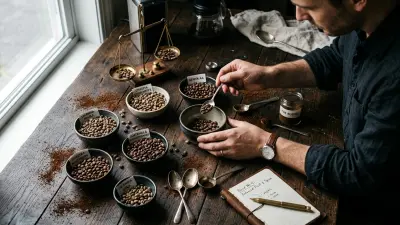
- Tasting Notebook & Pen: Your most valuable tool! Record every detail: bean origins, ratios, roast levels, brewing method, and detailed tasting notes.
The Blending Process: Step-by-Step for Beginners
Step 1: Define Your Goal
What kind of coffee are you trying to create? A bold espresso blend? A smooth, balanced drip coffee? A bright, aromatic pour-over? Having a target profile will guide your choices.
- Example Goal: A balanced, medium-bodied blend with chocolatey notes and a hint of fruit for my morning French press.
Step 2: Select Your Origins
Based on your goal, choose 2-3 single-origin coffees that you believe will complement each other. Think about their strengths and weaknesses:
- Do you need a heavy body? Consider a Brazilian or Sumatran.
- Want brightness? Look to an Ethiopian or Kenyan.
- Need a sweet base? A good Colombian or Guatemalan often works.
A common strategy is to combine a "base" bean (e.g., a balanced Colombian or Brazilian) with an "accent" bean (e.g., a bright Ethiopian or an earthy Sumatran).
Step 3: Experiment with Ratios
This is where the magic (and meticulous note-taking) happens. Start with simple ratios and adjust. For your first blend, try combining two beans:
- Start with a 50/50 blend. Grind a small amount, brew, and taste.
- Try a 60/40 blend (60% of Bean A, 40% of Bean B). Taste.
- Try a 40/60 blend. Taste.
- If you introduce a third bean, start with something like 50/30/20.
Remember to keep everything else consistent – grind size, water temperature, brew time – so you can isolate the impact of the blend ratio.
Step 4: The Art of Cupping and Tasting
Critical tasting is paramount. Brew each blend iteration and taste them side-by-side. Pay attention to:
- Aroma: What do you smell?
- Acidity: Is it bright, tart, dull?
- Body: Is it light, medium, heavy? How does it feel in your mouth?
- Flavor: What specific notes do you taste (chocolate, fruit, nuts, floral, earthy)?
- Finish: How does the flavor linger after you swallow?
Be honest with your palate. What do you like? What needs more of something? What's overwhelming?
Step 5: Iteration and Refinement
Your first blend might not be perfect, and that's okay! Adjust your ratios based on your tasting notes. If it's too bright, reduce the bright origin or increase a more mellow one. If it lacks body, add a bean known for its richness. This iterative process is the heart of blending.
Tips for Blending Success
- Start Simple: Begin with just two beans. Master that before adding a third.
- Buy Small Batches: Experimentation can be costly. Purchase smaller quantities of various single origins.
- Keep Detailed Notes: This cannot be stressed enough. Your notebook is your blending bible.
- Blend After Roasting (Mostly): Unless you're an experienced roaster, blend pre-roasted beans. Different beans roast differently, so blending green beans can be tricky.
- Allow for Rest: Beans, once roasted and blended, benefit from a few days of rest (degassing) before brewing for optimal flavor.
- Trust Your Palate: There's no "right" blend, only the right blend for you.
Conclusion
Crafting your own coffee blends is a deeply rewarding journey that opens up a universe of flavor possibilities. It's a skill that combines art and science, allowing you to truly master your coffee experience. So, gather your beans, fire up your grinder, and embark on your blending adventure. Your perfect cup awaits!