Disclosure: As an Amazon Associate, we earn from qualifying purchases.
There is a distinct magic in plunging a French Press on a quiet morning, anticipating that heavy, velvet cup of rich coffee. Yet, far too many home baristas end up with a mug that tastes either unpleasantly bitter, watery and weak, or intensely astringent. While bean quality and water temperature play supporting roles, the primary cause of inconsistent immersion coffee comes down to simple math. Understanding how coffee grounds interact with water volume transforms a haphazard kitchen experiment into a repeatable ritual of precision and exceptional flavor.Quick answer: The golden rule ratio for French Press brewing is 1:15 (1 gram of coffee for every 15 grams/milliliters of water) for a robust, full-bodied cup, or 1:16 for a slightly lighter, more balanced extraction. For a standard 8-cup French Press (34 oz / 1000 ml of water), use approximately 60 to 67 grams of coarsely ground coffee filtered at 200°F (93°C) for four minutes.
The Science Behind Immersion Brewing and Extraction
Unlike drip or pour-over methods like the Hario V60 or Chemex, where fresh water continuously percolates through a bed of grounds, a French Press relies entirely on full-immersion extraction. In an immersion environment, the water sits with the grounds for the entire duration of the brew. As time progresses, the solvent strength of the water gradually decreases as it becomes saturated with extracted coffee solubles. This thermal and chemical dynamic changes how fast flavor compounds dissolve, making precise measurement critical to preventing over- or under-extraction.
According to the Specialty Coffee Association (SCA) standards, an ideal cup targets a total dissolved solids (TDS) reading between 1.15% and 1.45%, achieving an extraction yield of 18% to 22% of the coffee bean's mass. When your brew ratio strays too far toward coffee (such as 1:10), the water becomes saturated too quickly, yielding an under-extracted, sour, and overly intense beverage. Conversely, using too much water (such as 1:18 or 1:20) forces the water to extract harsher, woodier tannins late in the steep time, resulting in an astringent, drying mouthfeel.
To reach the sweet spot where sweet sugars, floral aromatics, and rich organic acids balance out, you must treat your water and coffee mass as an exact equation. Volume measurements using kitchen scoops or glass measuring cups introduce massive variations; dark roast beans are far less dense than light roasts, meaning a single scoop of dark roast might weigh 7 grams while a light roast scoop weighs 11 grams. Utilizing a digital scale sensitive to 0.1 grams eliminates this guessing game entirely.
Deciphering the Golden Ratios: Matching Flavor to Preference
While the standard baseline for French press immersion sits around 1:15 to 1:16, there is no single absolute ratio that fits every palate or coffee roast profile. Lighter roasts from regions like Ethiopia or Kenya often benefit from slightly higher water ratios to draw out complex fruit notes and subtle acidity without being overwhelmed by heavy body. Darker roasts, rich in dark chocolate and roasted nut notes, perform exceptionally well with lower ratios that highlight body and minimize harsh late-stage extraction compounds.
Choosing the right ratio allows you to adjust the final texture and strength profile without altering your grind size or steeping time drastically. Below is a detailed breakdown of how different coffee-to-water ratios alter the sensory characteristics of your French press brew across various standard vessel sizes.
Ditch the Scoop: The Secret to Hitting the Golden Ratio

| Ratio Profile | Flavor & Body Profile | Coffee Dose (3-Cup / 350ml) | Coffee Dose (8-Cup / 1000ml) | Recommended Roast Level |
|---|---|---|---|---|
| 1:14 (Strong) | Syrupy body, heavy mouthfeel, highly concentrated, muted floral notes. | 25 grams | 71 grams | Dark Roasts, Espresso Blends |
| 1:15 (Golden Standard) | Rich, velvety texture, prominent origin sweetness, lingering finish. | 23 grams | 67 grams | Medium-Dark to Medium Roasts |
| 1:16 (Balanced) | Clean finish, moderate body, high clarity, expressive acidity. | 22 grams | 62 grams | Medium to Light Roasts |
| 1:17 (Mellow) | Light body, tea-like mouthfeel, highlights high delicate notes. | 20 grams | 58 grams | Ultra-Light / Single-Origin Roasts |
When selecting your ratio, consider what addition you plan to make to your finished cup. If you enjoy pouring whole milk, oat milk, or heavy cream into your morning mug, targeting a denser 1:14 or 1:15 ratio guarantees that the underlying coffee structure holds up against the dairy fats without tasting diluted.
Grind Size, Water Temperature, and Steeping Variables
Mastering the ratio is only half the battle; the geometry of your coffee particles determines how effectively that ratio dissolves. For French press, a coarse to medium-coarse grind setting is traditionally recommended—roughly around 800 to 1000 microns in size, resembling coarse sea salt. Using a quality burr grinder, such as a Baratza Encore or Fellow Ode, ensures uniform particle size and significantly reduces the creation of microscopic fines that pass straight through metal mesh filters.
Water quality and thermal stability are equally vital. Coffee is roughly 98.5% water, meaning tap water with high chlorination or excess mineral hardness will ruin even the most expensive single-origin beans. Aim for filtered water heated to 195°F–205°F (90°C–96°C). Boiling water left off the heat source for roughly 45 to 60 seconds usually lands right inside this critical zone, preventing thermal scorching of the grounds during the initial bloom.
Barista's tip: A frequent mistake home brewing enthusiasts make is plunging the press immediately at the 4-minute mark and pouring. Instead, at minute 4, use a spoon to gently break the thick crust of floating grounds on top, allowing them to settle to the bottom. Let the pot sit untouched for an additional 3 to 5 minutes without plunging. The sediment settles below the filter naturally, yielding an remarkably clean, sediment-free cup with rich body rivaling professional café service.
Establishing a repeatable steeping protocol keeps your results consistent day after day. Here is the step-by-step workflow for achieving an optimal extraction yield using the classic golden ratio:
- Weigh and Grind: Dose out 60 grams of fresh whole-bean coffee (roasted within 2 to 4 weeks) and grind to a uniform medium-coarse setting.
- Preheat Equipment: Rinse your glass or stainless steel French press vessel with boiling water to warm the walls, then discard the rinse water.
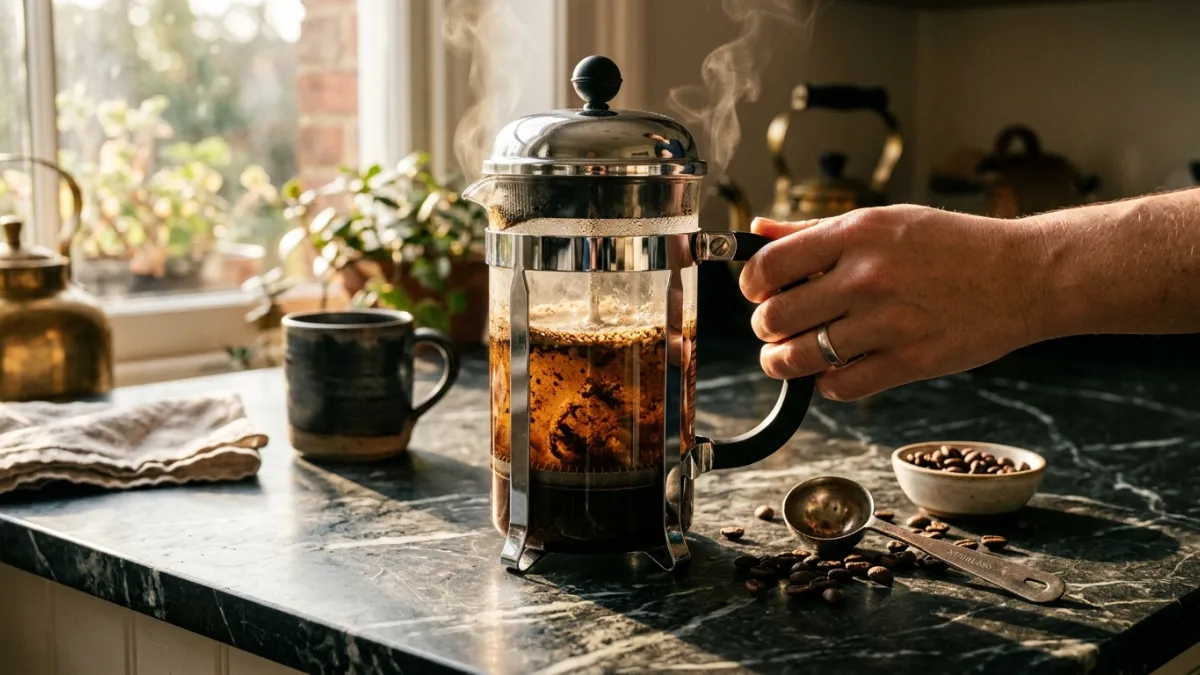
- The Bloom Phase: Pour roughly twice the weight of coffee in hot water (120 g of water for 60 g of coffee) over the grounds. Stir gently once and wait 30 seconds to allow trapped carbon dioxide gas to escape.
- Main Fill: Slowly pour the remaining hot water up to your target weight (900 g total for a 1:15 ratio). Place the plunger lid on top to trap heat, but do not press down.
- Crust Break and Settlement: At the 4-minute mark, remove the lid, break the top crust with two spoons, scoop away excess floating foam, and wait another 3 to 4 minutes for particles to sink naturally.
- Press and Serve: Lower the mesh screen just beneath the surface of the liquid to act as a pour strainer, and gently pour the brew directly into heated ceramic mugs or an external carafe.
Troubleshooting Common Flavor Profiles
Stop Breaking Glass: Upgrade to Double-Wall Insulation

Even with an exact golden ratio, small variations in grind distribution or water chemistry can shift the overall balance of your extraction. Recognizing sensory indicators allows you to make swift adjustments to your routine for subsequent brews.
If your coffee tastes sharp, unpleasantly sour, or lacks a satisfying finish, you are dealing with under-extraction. This occurs when solubles fail to fully dissolve out of the bean matrix. To fix this without altering your 1:15 ratio, slightly refine your grind size closer to a medium setting or increase your water temperature closer to 205°F (96°C) to accelerate extraction velocity.
On the flip side, if the coffee leaves a harsh, dry, or bitter coating on the back of your tongue, the brew has over-extracted. This is caused by extracting past the desirable organic compounds and drawing out bitter polyphenols. Remedy this issue by coarsening your grind setting, lowering your brewing water temperature, or shifting your ratio from 1:15 to a slightly wider 1:16 dilution.
The Ideal Setup for Home Baristas
To consistently execute high-grade immersion coffee, prioritize your equipment investments wisely. A precision digital scale with an integrated timer should be your first purchase, followed immediately by a dedicated conical or flat burr grinder. Blade grinders split coffee beans unpredictably, producing both large boulders and micro-dust that muddy the French press screen regardless of how accurate your water ratio is. By pairing precise measurements with consistent particle distribution, you can master immersion coffee and customize every pot to your exact flavor preferences.
Frequently Asked Questions
What is the absolute best ratio for an 8-cup French press?
An 8-cup French press typically holds 34 fluid ounces or 1000 milliliters of water. For a rich, balanced extraction using the 1:15 golden rule, use 67 grams of coarsely ground coffee to 1000 grams (1 liter) of hot water.
Why Blade Grinders Wreck Your Brew Ratio

Can I leave brewed coffee inside the French press after plunging?
No, leaving brewed coffee inside the press allows the water to remain in continuous contact with the fine silt sitting at the bottom of the vessel. This causes persistent over-extraction, resulting in a bitter, lukewarm final cup within minutes. Always decant your brewed coffee completely into a warm thermal carafe or serving mugs immediately after steeping.
Should I use a fine grind if I prefer a stronger cup of coffee?
Using a fine grind in a French press is not recommended because small particles slip through the metal mesh filter, creating a muddy texture and gritty mouthfeel. Furthermore, fine particles clog the filter screen, making the plunger extremely difficult and hazardous to push down. To make a stronger cup, increase your coffee dose (such as shifting from a 1:16 ratio to a 1:14 ratio) while keeping a coarse grind size.
Does dark roast coffee require a different ratio than light roast?
Yes, dark roasts are more porous and dissolve into water much faster than dense light roasts. Using a slightly wider ratio like 1:16 or reducing your water temperature to around 195°F (90°C) prevents dark roasts from tasting burnt or excessively bitter. Light roasts benefit from a tighter ratio like 1:15 and higher water temperatures near 203°F–205°F (95°C–96°C) to maximize sweetness and acidity.
Sources
- Specialty Coffee Association (SCA) Standard Brewing Guidelines
- Wikipedia: French Press Method and Extraction Physics
- Baratza Grinder Calibration and Particle Distribution Manuals
Looking for the Right Brewing Gear?
Check out our verified Top Coffee Brewing Essentials on Amazon.
As an Amazon Associate, we earn from qualifying purchases.